Skip to content

Category: Uncategorized

The British Constitution Part 3: Contracts, Chums, and Charlatans

Prime Minister Boris Johnson dressing up to ‘lead from from the front’ as the country slides into chaos

Preface

Each time I try to focus on setting out a long term view of the trials and tribulations that beset our increasingly battered and scarcely recognisable ‘British Constitution’, the short termism of everyday politics keeps breaking in. The present moment sees us in an unprecedented constitutional situation. The shifty and self-serving Prime Minister, Boris Johnson, has been ditched as leader of the Conservative Party, but remains in office as Prime Minister. While Britain burns, he disappears on holidays, or parties, or appears in several photo opportunities that suggest he is auditioning for some imagined future military role as a pilot or gunner or tank commander, while draped in a union jack. The one thing he does not dress up for is the role of a real live Prime Minister, the job for which he is paid and for which he remains responsible in times of crisis. And there’s no mistaking the national crises that are crowding in: the burgeoning cost of living crisis, the related energy crisis, the crisis in public services staffing and provision, the environmental crisis, the international relations crisis, the crisis in our European relationships, the crisis in our public morality. While drawing his Prime Ministerial salary and perquisites, Johnson refuses to address any of these issues, saying that they must be left to whoever replaces him as Prime Minister. This is, of course, an abject dereliction of duty on his part, the equivalent of throwing his toys out of the pram.

Who will address these problems and when? There is sheer paralysis in the central government. It almost defies belief that the whole country is obliged to wait and watch in dismay as the Tory party plays out at excruciating length the charade by which its tiny membership of 160,000 (predominantly white, male, pensioners) is allowed to choose our next Prime Minister. We have to watch between our separated fingers an unedifying contest in which the two candidates left standing, Rishi Sunak and Liz Truss, try to outdo each other in their increasingly frantic appeals to a hard right agenda they believe those members to espouse.

If allowed a choice, most of us would record: ‘none of the above’. Terrifyingly, current opinion polling of the Tory membership suggests that Truss is likely to win out: terrifying because her undistinguished record, her unconvincing aping of Maggie Thatcher, the increasingly dismal and ill-informed banality of her political rhetoric, and the absence of any discernible moral compass, suggest that she is every bit as unfitted to lead the country as her predecessor. As I write, she is reported to have accused the civil service of antisemitism and intends to root it out, drawing an indignant response both from civil service leaders and Jewish representatives. I’d suggest she is more likely to encounter antisemitism among the Tory members whose support she seeks. And she would be wise to remember that if she becomes Prime Minister she will depend heavily on that same Civil Service to design and implement the policies she seeks to introduce (or what’s left of the Civil Service when her right hand acolyte Rees-Mogg gets rid of 90,000 of them). Is she losing the plot? Will she crash and burn? Watch this space…. 

Part 3 Contracts, Chums, and Charlatans

My focus so far on contemporary problems with the British Constitution and the political system has been on the broad concept of ‘the rule of law’, and various attempts by the current political leadership to undermine both concept and practice, so that they can avoid the normal rules. In this piece I want to examine practices that often fall somewhere between the legal rules and the moral social norms that most of us try to live by. These can be grey areas, all too often activities and relationships that are shrouded in secrecy. Powerful people thrive most in this environment because they can use their formidable resources to avoid or manipulate the legal process. Their actions may anger us because there seems to be ‘one law for them, another law for the rest of us’. Or if they appear to live without any regard for conventional social and personal morality they may not be acting illegally, but would earn our distaste and disrespect, even our contempt (remind you of anyone?). At worst, though, these powerful people may simply not care what the rest of us think.

The Tory party, which has been in government now for 12 years (if you count the Tory/Lib Dem coalition), have been described recently as “the party of spoilt unruly aristocrats” and as “a priestly caste”, a social and political elite who feel themselves entitled by birth, education and social position to govern in their own interest and to the advantage of their equally elite friends and supporters. This is one reason why it seems apt to compare this group, and their ‘new’ corruption with the ‘old corruption’ of aristocratic elites in earlier centuries.

Dodgy contracts and dubious chums

Guardian: Boris Johnson and Dominic Cummings in Downing Street in 2019. Photograph: Daniel Leal-Olivas/AFP/Getty

There have been many examples of both categories, and the participants keep recurring under both labels, since a major feature of recent years of Tory rule has been the secretive award of significant numbers of lucrative taxpayer funded state contracts to an unappetising mix of Tory friends, relations, members and donors. These are too numerous to list here, and pending further revelations from the major inquiry that Johnson has so far succeeded in booting well down the road, let’s focus on those examples that are most telling because we know more about them.

The NHS and the Pandemic

At the beginning of 2020 the Covid 19 pandemic was initially ignored and scoffed at by Prime Minister Johnson, who crucially missed five meetings of the top level emergency Cobra committee intended to deal with such national crises. But the pandemic was ultimately a face saver for Johnson as he wrestled with post-Brexit difficulties. Despite egregious errors and missteps (that some medical experts judge may have cost up to 20,000 deaths), he was boosted by the success of the search for effective vaccines. Desperate to row back from the misfiring attempts to reduce the incidence of infections and deaths both in hospitals and the social care sector, Johnson’s government needed a rapid response to make good substantial deficiencies in the supply of personal protective equipment (PPE: face masks, ventilators, specialist clothing) and testing kits for a new track, test and trace system.

A major decision was (obscurely) made to create a ‘fast’ VIP lane for the award of commercial contracts to supply the goods and services that were thought necessary. We now have ample evidence that nominations to this fast lane were primarily made both through specific invitations to favoured large contractors such as Serco, and by nominations though a range of Conservative Party links, including Ministers themselves, several party donors, and other party activists. The normal rules of ‘due process’ to protect against fraud and mismanagement were set aside, and later analysis showed that providers nominated to the VIP lane had a significantly greater chance of being awarded contracts. Unsurprisingly, serious errors were made, and poor outcomes were substantial. These are illustrated by:

The case of Randox

The players in this most damning case were:

  • Owen Paterson, a former Tory Cabinet Minister and MP for North Shropshire
  • Randox, a healthcare company which paid Paterson £100,000 a year to lobby government on their behalf, which broke Parliamentary rules; and between 2010 and 2018 Randox donated £160,000 to the Conservative Party
  • Health Secretary Matt Hancock, who had several meetings with both Paterson and Randox at a time when ‘fast lane’ contracts were under consideration, (and who would himself be fingered for nominating his wholly unqualified local pub landlord to the VIP lane)
  • Prime Minister Boris Johnson, who sought to defend Paterson from parliamentary censure when a Guardian investigation revealed his improper lobbying for Randox, but was compelled by a large backbench rebellion of his own outraged MPs to give way to Paterson’s resignation in November 2021. The defeat for the Tory candidate at the subsequent bye-election was almost certainly a major contributing factor to Johnson’s own later downfall in July 2022.

The whole saga was laid bare in a July 2022 report from the prestigious House of Commons Public Accounts Committee (PAC). They found that Ministers and officials had played “fast and loose” when awarding contracts worth £777m to Randox. These were awarded in 2020 without any competition. The PAC Report noted: “Randox struggled to deliver the expected level of testing capacity against its first contract…Yet the department still awarded Randox a contract extension worth £328m seven months later, again without competition”. While both Hancock and Randox denied any impropriety, the PAC concluded that because of poor record keeping it was impossible to establish that the contracts were properly awarded, or whether they produced excessive profits, though the firm’s profits for the year to 2021 were “more than 100 times greater” than for the previous year. Hancock’s role remains obscure, but he had in any case been brought down by then by a different piece of sleaze in June 2021, involving dodgy kisses rather than dodgy contracts.

Randox is an outstanding case of all that went wrong with government procurement and the dubious links to Tory party politics. The wider picture was laid out in a Report in March 2022 by the National Audit Office, an independent Parliamentary body responsible for auditing public accounts and expenditure and ensuring value for money in the management of public funds. This Report is one to make you blink in disbelief at the possible financial losses we as taxpayers must ultimately bear through the inefficiencies, waste, fraud and corruption associated with this whole contracting episode. The main points to be registered are these:

  • DHSS awarded 394 contracts worth £7.9bn: 115 of these contracts went through the VIP lane, 46 without any process of ‘due diligence’
  • Of 31.5 bn items received, only 17.3bn were actually delivered to front line services
  • 14.2bn items remain in storage at a cost as of October 2021 of £737m
  • 10% of these items are not now needed, while 11% of all items received were considered unfit for purpose
  • more than half of VIP suppliers provided equipment that was unsuitable
  • 176 contracts remain in dispute with a further taxpayer loss of £2.6bn at risk

Prime Minister Johnson, former Health Secretary Matt Hancock, and other Ministers have defended this poor set of outcomes on the basis of the urgency of the crisis at the time, but the VIP Lane scenario inevitably leaves a bad smell. Much remains to be investigated and uncovered. The difficulty of pinning down possible miscreants is illustrated by the case of Tory peer

Lady Michelle Mone

Tory Peer Michelle Mone with billionaire husband Douglas Barrowman

Lady Mone is a successful business entrepreneur, ennobled as a life peer by David Cameron. She is now married to Douglas Barrowman, a billionaire who made a large part of his fortune through the promotion of tax avoidance schemes described by tax reform campaigners as ‘repugnant’ and much favoured by the Tory Party’s many City friends. Fittingly, he and his wife live in the tax haven of the Isle of Man. Lady Mone was connected to a firm called PPEMedpro, (in which Barrowman had a financial interest). At her instigation, through the Tory peer Lord Agnew, this company was referred to the VIP lane for PPE contracts. The company then received two contracts worth £200m. One of these contracts failed to deliver any usable medical gowns, but PPEMedpro refused to return any of the £49m they had received. A case of potential fraud is being pursued by police through a National Crime Agency investigation, which has gathered evidence from documents and other materials from the Mone/Barrowman home in the Isle of Man.

From the very outset of these investigations Lady Mone denied any connection with the PPEMedpro business, but evidence quickly emerged to undermine these denials, so that in effect she also stood accused of lying. There was also evidence that she had sought through political contacts to obtain further contracts in relation to testing kits. A DHSS Minister has refused to release documentary evidence on this case, which “reeks of a cover up” according to Labour’s Deputy Leader Angela Rayner.

So: a Tory peer who appears to be anything but a glowing role model for young business people, married to a purveyor of ‘repugnant’ tax avoidance schemes, allowed through their political friends to perpetrate an enormous waste of taxpayer funds in a time of crisis through a scheme later declared illegal by the High Court. But will these dodgy practices and dodgy relationships attract any penalties? Not, I think, if we get a Prime Minister Truss, certain to avoid any real accounting for an iniquitous scheme endorsed by a Cabinet of which she was a leading member.

At least the January 2022 judgement by the High Court, ruling on a challenge brought by the Good Law Project, found this whole procedure to be “unlawful”, and that such “illegality” could not continue. The particular cases on which the judgement rested had been made on “a flawed basis” and showed that the majority of products supplied were defective and/or unusable. Jo Maugham, Director of the Good Law Project said “never again should any government treat a public health crisis as an opportunity to enrich its associates and donors at public expense”.

Lobbying, Donations, and Revolving Doors

The components of corruption in public life are clear enough in themselves: lobbying Ministers, peers and MPs to obtain influence over decisions and awards; making party donations to much the same groups, to make it more likely that that contracts will be awarded, honours gifted, inconvenient regulations and rules axed; cementing such access to power by appointments of favoured political allies to key public and private positions, a process we label revolving doors.

Again, these interacting relationships are not always easily pinned down and exposed, particularly where the party in political power, controlling the chief institutions of the state, actively uses its undoubted patronage in its own interests. We can best illuminate such practices by specific examples, and here we turn to what became the notorious case of

Cameron and the Greenhill Affair

Former Prime Minister David Cameron (left) with banker Lex Greensill on a lobbying visit to Saudi Arabia’s leader, Prince Mohammad bin Salman in January 2020

This controversy involved the shadowy relations between David Cameron, Prime Minister from 2010-2016, and an Australian financier called Lex Greensill, and his company Greensill Capital. Unusually, Greensill was allowed what one report called “extraordinary privileged access” to 10 Downing Street and also to at least ten government departments. This access allowed him to develop contacts inside the heart of government, and promote Greensill Capital projects, particularly in relation to health service activities. Some of these projects would have involved taxpayer-based insurance against failure. This unusual situation was in a subsequent internal Cabinet Office inquiry conveniently blamed on the then Head of the Civil Service, Jeremy Heywood, later Lord Heywood: conveniently, because he had meanwhile died and was unable to explain or defend himself.

Much more concerning is what happened after Cameron’s departure from No 10 in 2016 after losing the extremely ill-judged and disastrously formulated Brexit referendum. In 2018 Cameron took up an advisory role with Greensill Capital, the reward being calculated, as salary and bonuses, at approximately £7m (before tax) for what amounted to 2½ years of part time work. This did not in itself break any existing rules. But what should raise our eyebrows more than somewhat is the story of Cameron’s persistent and highly personal lobbying on Greensill Capital’s behalf for government support which would have conveyed an enormous financial benefit to Cameron’s own finances as a major shareholder in the firm. He drew on his own former high level contacts in the Treasury, including Chancellor Rishi Sunak, and persistently lobbied two very senior Treasury officials. This whole story only emerged after Greensill Capital collapsed into insolvency in March 2021.

While this lobbying assault on the Treasury by a former Prime Minister ultimately bore no fruit, and Greensill collapsed anyway, there was major political and public criticism of Cameron’s actions and his unwillingness to reveal the considerable extent of his financial benefits from the position he held in the failing company. A Public Accounts Committee report found that £335m of taxpayers’ money was at ‘increased risk’ due to woefully inadequate checks on Greensill Capital. The various official inquiries into this affair found that while Cameron had not broken any formal rules, he had understated his real relationship with Greensill and had ‘showed a significant lack of judgement’. This perhaps should come as no surprise, given a similar lack of judgement over the Brexit issue. How do these people get to be Prime Minister, and why are we to get a hopelessly third grade and inept one such again in a couple of weeks?).

This case is instructive because

  • it shows how much the quality of our political and constitutional system has deteriorated in recent times: it’s difficult to imagine Harold Macmillan or Margaret Thatcher or John Major acting in Cameron’s shamelessly self-serving way on leaving office. His behaviour is notably ironic, given that a decade earlier he had pronounced that lobbying was an unacceptable practice that he intended to reform; a reform which was described by a member of the overseeing committee as “a dog’s breakfast”
  • it demonstrates the risks when the boundaries between state and business sectors are rendered so permeable that conflicts of interest become unavoidable for political actors who should be protecting the public interest
  • the issue of ‘revolving doors’ could not be more clearly illustrated: here, Lex Greensill’s revolving door into 10 Downing St is mirrored later by Cameron’s revolving door into lucrative transactions with Greensill Capital. Clear conflicts of interest are neither declared nor regulated. In short, if no rules were broken in this case, the rules need to be significantly strengthened

Lest We Forget     

In looking at specific recent examples of questionable ethics in government, I have necessarily been unable to consider the very many other cases that have disfigured government decision making in the past decade.

Private Eye’s satirical take on the shipping contracts scandal

WHO CAN FORGET ‘Failing Grayling’ (thank you John Crace of The Guardian), who when Minister of Transport awarded ferry contracts to a dodgy company that had no ships and no port connections? And who had to settle out of court compensation of £33m with Eurotunnel over awarding such contracts in what was described as a “secretive and flawed” process? It has been estimated that while Transport Secretary Grayling had misspent £2.7bn of public funds (already in 2013 he had as Justice Secretary introduced a botched prisons and probation reform estimated by the National Audit Office to have cost £171m in terminated private sector contracts.) His reward? A sinecure with another tax haven based shipping company of £100,000 for a 7 hour working week; disgracefully, this is alongside his salary as a sitting MP. You could not make it up. In the 2019 General Election, Grayling was re-elected by the voters of Epsom and Ewell with an increased majority. Did they never take notice of what their appalling MP was up to?

WHO CAN FORGET the many failures of contracts awarded to the company Serco (boss Rupert Soames, brother of Tory grandee Sir Christopher Soames)? The most egregious related to the ill-conceived and ill-managed Track, Test and Trace programme, the National Audit Office judging that overall there was no evidence that the £22bn programme had reduced rates of Covid19 in England.  And there were other cases: Serco was in 2019 fined £23m for failures in its contract for electronic tagging of prisoners; and had also been fined for poor delivery of housing for asylum seekers; and meanwhile said Chief Executive Rupert Soames was in 2020 paid £4.9m, 61 times more than the pay of his average employee, as Covid-related contracts boosted company revenues.

Health Secretary Hancock backed a loser in Baroness Dido Harding

WHO CAN FORGET, talking of Track, Test and Trace, the hapless and clueless Baroness Dido Harding, Tory Life Peer created by her friend and then PM David Cameron? Having badly failed as Chief Executive of the media company Talk Talk, her appointment through close political associate and horse racing friend Health Secretary Matt Hancock, raised murmurings of ‘nepotism’. Together they presided over multiple failures linked to this expensive and wasteful programme, employing consultants who cost £1m a day, days in which hundreds of junior employees often sat around doing nothing, because the system was not working. Unbelievably, Dido’s husband MP John Penrose at this time held the position of Anti-Corruption Champion to the Home Office. You wonder about their conversations over the breakfast table…

The worry is that there may never be a proper and full holding to account for all these serial failures and cosy contractual relationships between Tory Governments and Tory donors, MPs, supporters, and even family relations. PM Johnson carefully structured the official public inquiry under Baroness Hallett to be delayed well into the future; the agreed terms of reference were only published in June 2022. Probable Prime Minister-in-waiting Liz Truss has also made clear her intention to do the same booting-down-the road. Given the many other national crises, political interest in the failures of crisis management in the past two and a half years may fade. Johnson will go on a spree of lucrative engagements as the people he rewarded with jobs, contracts and honours while in office make sure to return his favours. That’s the way corruption works the world over, and that’s how it works here and now; sadly, we always thought Britain was better than this.

In a week or so, Johnson will finally depart, but not without a Big Honours Bang, where we’ll see possibly the worst and most extensive honours list since Lloyd George. I’ll be making that comparison next time in Part 4.

3 Comments

THINGS FALL APART: THE CENTRE CANNOT HOLD

“Events, my dear boy, events” is what Harold Macmillan (pictured left) is reputed to have answered when asked about the difficulties facing a Prime Minister. Events may finally have caught up with Boris Johnson, pictured right.

My heading is from a W.B. Yeats poem The Second Coming, but is a reminder of the title of Chinua Achebe’s wonderful novel with its reflections on politics and corruption in colonial Nigeria.

Just when I thought I was in the middle of a carefully considered long term view of what is happening in British politics and government currently, things did fall apart at the centre. As I write, this leaves the British political system in a state of woeful and chaotic confusion. The fundamental reason for this situation was Prime Minister Boris Johnson’s determination to resist all calls for his resignation. These in turn were the end-point of a long series of errors, U-turns, and accusations of sleaze and corruption centred on 10, Downing Street. All this was capped by the almost incredible story of ‘partygate’ and its revelation that both Johnson and other senior members of the Prime Minister’s team at the heart of government had broken the very laws that they were issuing and promoting.

The only surprising thing about the debacle was the sudden implosion of Johnson’s position as Prime Minister and leader of the Conservative party. The ostensible trigger was the sudden resignation of two of his senior ministers, Chancellor Rishi Sunak and Health Secretary Sajid Javid. Some commentators attributed the collapse to a sleazy incident involving a Tory Whip, Chris Pincher, which revealed that Johnson had demonstrably failed to heed warnings of the known unsuitability of Pincher for this appointment. Johnson subsequently lied about this and was outed by no less a figure than Sir Simon McDonald (now Baron McDonald of Salford), a former Permanent Secretary at the Foreign and Commonwealth Office when Johnson was Foreign Secretary. Referred to by ‘The Daily Mail’ as the ‘remainiac mandarin’, we might note that McDonald had frequently clashed with his erstwhile Foreign Secretary, and Johnson retaliated as Prime Minister by replacing him. McDonald appeared to wait for the right moment; as the saying goes ‘revenge is a dish best served cold’.

However, the underlying reason for the crucial ministerial and other resignations must surely have been the two significant electoral defeats for the Conservatives in Wakefield and Taunton Deane, which will have frightened the socks off almost all Conservative MPs. Suddenly their whizz-kid Prime Minister was revealed as a vote loser and a toxic asset. These results suggested that in any forthcoming election under Johnson the Tory party could give way to a Labour government, losing a wide range of both so-called Red Wall seats in the North East and Midlands, and what might normally have been regarded as ‘safe’ Tory seats in more prosperous areas of the country. The writing was now on the wall, and Johnson was forced out as leader of the party (but not yet as Prime Minister).

From Hubris to Nemesis – but not yet Catharsis

Let us hope that Johnson both understands and appreciates this kind of development and language. Johnson had stormed to his long-desired capture of Prime Ministerial office by a combination of dirty tricks over the Brexit referendum, and extremely questionable attacks on the position and powers of Parliament. His subsequent electoral victory in January 2019 gave him a substantial majority, allowing him to play fast and loose with several constitutional conventions. Although he was reeled in with adverse judgements on his illegal actions by the High Court and Supreme Court, he continued to push the boundaries of normal political and administrative practice. He was helped in this not only by delays in the implementation of Brexit but by the crisis created by the Covid-19 pandemic. Initially he and his team handled this extremely badly. He was saved from ignominy by the astonishingly rapid development of effective vaccines and heroic efforts by the NHS. But a different kind of ignominy has not yet been fully played out, relating to a substantial number of wasteful and potentially corrupt contracts to suppliers linked to members of and donors to the Conservative party and government. We know already that several billions of pounds of taxpayers’ money have been squandered but we still await a full accounting for this whole series of dubious transactions. This is the theme of sleaze and corruption to which I will return in my next post.

So Johnson has gone – or has he? While the Tory party is now tearing itself apart as it attempts to find a successor who will not be as disastrous as Johnson has proved to be, he still remains as Prime Minister for at least another two months. Given his track record, it is impossible to say with confidence that he will not renege on his pledge to avoid controversial new initiatives or decisions. Moreover, we face the prospect of enduring yet another series of elevations to the House of Lords and other honours which will produce some sort of toxic afterlife in our government institutions.

Two worrying issues arise here. The first is that a new Conservative cabinet looks quite likely to find a number of the same faces in it, committed (as it would seem from declarations from the candidates) to mutually contradictory economic policies, to carrying forward controversial proposals which still remain on the parliamentary timetable. The most notable of these are the bill to renege on the Northern Ireland Protocol as part of the Brexit settlement, and the attack on existing human rights legislation. In addition, the universally scorned policy to resettle would-be asylum seekers in Rwanda in central Africa may well be continued. All of these policies have already attracted accusations that they break both national and international law. (And we are not allowed now to protest about this, or even about the failure to pursue adequate environmental programmes.)

The second concern I have is that both Johnson as outgoing Prime Minister and an incoming ‘new’ Conservative administration will strain every political sinew to avoid accountability for a number of extremely dodgy past actions. Firstly in relation to the handling of the pandemic, the award of questionable contracts, and also such issues as catastrophic failures in our benefits and social care systems, ineffective housing programmes, and even more privatisation and underfunding of our hard-pressed and highly-regarded NHS. So Johnson may be leaving us, but his legacy is likely to poison the water for some time to come.  At this point a quotation from Shakespeare’s Julius Caesar may resonate:

“The evil that men do lives after them; The good is oft interrèd with their bones.”

4 Comments

BACK TO THE FUTURE: FROM OLD CORRUPTION TO NEW CORRUPTION Part Two

Prime Minister Boris Johnson answering questions on ministerial code: Credit Daniel Leal-Olivas/Pool/AFP/Getty Images

 Part 2 : What Is Happening to Principles of Public Morality?

One of the most tainted jobs in public life

Jessica Elgot in The Guardian, 16 June 2022, on ethics advisers.

To begin at the beginning, let’s return to the issues raised in Part 1 of this blog by the resignations of no less than three ethics advisers over the policing of the Ministerial Code. This Code sets out the standards of public life that Ministers (including the Prime Minister) promise to observe, with the expectation that serious breaches would entail ministerial resignation. There is a similar Code of Conduct for MPs, members of the House of Lords, and civil servants; oversight of the system is the responsibility of an independent Committee on Public Standards, which is not a formal regulator and reports to the Prime Minister.

The Prime Minister also appoints an Independent Adviser on the Ministerial Code. There is currently nobody in this post, since Lord Geidt has now resigned after a disagreement with the Prime Minister, much  as his predecessor Alex Allan had done over infringements of the Code by the Home Secretary, Priti Patel. Another resignation along with Geidt’s came from MP Jonathan Penrose, appointed by Johnson to be his ‘anti-corruption tsar’ (a somewhat risible title, with its echoes of one of the most authoritarian systems of rule in European history). Geidt and Penrose both referred to the way in which the Prime Minister appeared to be excluded from judgements under the Code: ‘at the moment’ said Penrose ‘the Prime Minister appears to have an exception, and that means there is no public advice for parliament and everyone else to see, which isn’t fair at all’. Geidt is quoted by an anonymous source as saying that ‘ he was sick of being lied to’.

It’s worth noting the public service record of these people who are at odds with Johnson. Alex Allan was a very senior and experienced civil servant, a senior intelligence chief, and Principal Private Secretary to two former PMs, Tony Blair and David Cameron. Lord Geidt, another civil servant, had held the prestigious position of Private Secretary to the Queen. Penrose had been a former Tory minister. Johnson had also offended another watchdog, Jonathan Evans, former M15 Chief and Chair of the Committee on Public Standards, by not accepting in full a range of reforms recommended by the Committee in November 2021, Upholding Standards in Public Life, including the need for greater independence in the regulation of the Ministerial Code.

These public servants appear to inhabit a different world from that occupied by a Prime Minister seemingly oblivious to moral standards in public office, or indeed moral principles of any kind. To lose one ethics adviser might seem unfortunate: to lose three suggests both incompetence, and more alarmingly, complete indifference. In his resignation letter Lord Geidt accused the PM of putting him in an ‘impossible and odious position’ after asking him to give advice on ‘a deliberate and purposeful breach of the ministerial code’ in pursuit of a plan to ‘risk breaking international law’; ‘the idea that a Prime Minister might to any degree be in the business of deliberately breaching his own Code is an affront’.

 Very possibly, Johnson may leave to wither on the vine a set of ethical controls which he finds deeply unpalatable and a constant source of political embarrassment. What is worrying here is the evidence, also clearly demonstrated elsewhere, of a darker and more authoritarian intention to evade and undermine the rule of law. He and his Cabinet also seem intent on weakening institutions regarded in the past as central pillars of our system of governance, whether formal institutions like the law courts and local government, or areas of what is often called ‘soft power’, like the BBC and the Universities. It’s truly ironic that we now have a ‘Conservative’ government more committed to destruction than conservation, more inclined towards a set of culture wars intended to distract and divide our nation, rather than cultivate social harmony and political unity. Nor do our present set of Government ministers seem much interested in the pursuit of effective and efficient public policy: as an Observer leader commented (26 June 2022) ‘new policy announcements take the form of unworkable interventions that cause great harm for the sake of capturing newspaper headlines’.

Law-making and Law-breaking

The Partygate furore exploded when the Prime Minister (among many others working in his Downing Street office) was found by a police investigation to have committed a criminal offence, by breaking a law that he had himself put in place and promoted. The ethical question arising was whether such a conviction (the first of a serving Prime Minister in British history) involved a breach of the Ministerial Code. As we know, Johnson, acting as judge and jury, declared that it did not, then changed the ethical rules anyway. There remains a further test for him though, when he will have to appear before the parliamentary Select Committee on Privileges to answer on the equally serious question of whether he lied to, or misled Parliament about these infractions of the law. An adverse judgement by this cross-party Committee should in principle lead to the Prime Minister’s resignation. But it has been observed more than once recently that Boris Johnson would have to be dragged kicking and screaming from 10 Downing Street whatever the formal verdict reached by the Committee, which will not appear before the autumn.

This is not the only example of lawbreaking by lawmakers to be considered, for these issues arise in relation both to a new Home Office plan to deport asylum seekers to Rwanda, and proposed changes in legislation governing the Brexit agreement with the EU, also affecting quite long standing provisions on human rights.

Deporting Asylum Seekers to Rwanda

On the left: a small boat with Syrian asylum seekers crossing the English Channel.  (Photo: PA)
On the right: Home Secretary Priti Patel during during a walkabout at the Port of Dover (Kirsty O’Connor/PA)

This recently conceived plan by the Home Secretary, Priti Patel, is a response to a significant increase in the numbers of asylum seekers attempting to obtain refugee status in the UK. Essentially, after surviving terrible ordeals in war zones like Afghanistan and Syria, then a dangerous boat journey across the Channel, asylum seekers will officially, without further ado, be deported by plane to Rwanda in Central Africa.  This scheme, funded by the UK taxpayer, transfers responsibility (and cash) for the asylum seekers to the Rwandan government, a government with a notoriously poor human rights record, and a ludicrous destination for people from outside the African continent. This deportation plan has been criticised as a breach of the international laws on the proper treatment of asylum seekers, and is hugely controversial here in the UK. See below for examples

“appalling”

Prince Charles, heir to the throne

“this immoral policy shames Britain…the shame is our own, because our Christian heritage should inspire us to treat asylum seekers with compassion, fairness and justice, as we have for centuries”

the Archbishop of Canterbury and the entire senior leadership of the Church of England, who sit in the House of Lords

“government by gimmick”

Angela Rayner, Deputy Leader of Opposition, House of Commons

“Your children study the rise of Hitler in history and are asked how the people of 30s Germany allowed their country to slide into fascism. Well, now we can tell them. Kids, look out of the classroom window. It was like this…” 

Stewart Lee, Observer, 20 June 2022

“This tells us much about the British Government’s colonial and insulting view of Africa, as a place that is no better than a dumping ground for things – in this case people – it considers a problem”

Open letter from British cultural celebrities to Meeting of Commonwealth Leaders June 2022.
Signatories include Olivia Colman, David Harewood, Emma Thompson, Lemn Sissay and Benjamin Zephaniah

There were immediate legal challenges by refugee charities and human rights organisations, and the European Court on Human Rights (ECHR) intervened at the last minute to halt the planned first deportation plane (which reportedly has cost the British taxpayer £500,000). This interim judgement ultimately meant that all planned deportations will be deferred until a full consideration of the policy in the UK High Court. The ECHR polices the European Convention on Human Rights, and its judgements are binding on all member states of the Council of Europe, including the UK, (this is not an EU Court).

Furious Conservative MPs, egged on by the usual tabloid suspects like the Daily Mail and the Sun, demanded  that the UK should pull out of the European Convention on Human Rights, even though the UK had been the first to ratify it in 1951. There is a significant link here to the Labour Government’s Human Rights Act of 1998, which allows the rights enshrined in the Convention to be enforced in UK courts. Even more significant is that the ECHR guarantees human rights under the Good Friday Agreement in Northern Ireland.

The Johnson administration’s knee-jerk response was instantaneous: Dominic Raab, Justice Secretary and Deputy Prime Minister, announced a new Bill of Rights to replace the 1998 Human Rights Act. Raab says that the new law will allow the government to ignore ECHR injunctions and make it easier to remove asylum seekers to Rwanda. Considerable opposition to these proposals is expected, especially from the House of Lords. And Amnesty International (UK)’s Chief Executive Sacha Deshmukh lambasted the UK government’s politicking on this: ‘This is not about tinkering with rights, it’s about removing them. From the Hillsborough disaster, to the right for a proper Covid inquiry, to the right to challenge the way police investigate endemic violence against women, the Human Rights Act is the cornerstone of people power in this country. It’s no coincidence that the very politicians it holds to account want to see it fatally weakened.’

Meanwhile, England’s top lawyer, Chair of the Bar Council, accused the PM of ‘bullying’ the lawyers representing asylum seekers by claiming that they were ‘abetting the work of criminal gangs’. This attempt to demonise lawyers who are doing the job they are trained to do and expected to undertake without prejudice, is another political weapon in the Johnson government’s calculated assault on one of the essential constituents of the rule of law. The Guardian leader on 23 June 2022 judged ‘The dilution of fundamental rights and their subordination to ministerial opinion is a significant constitutional change. It is also a retrograde step for democracy’

Breaking and degrading international law: The Northern Ireland Protocol

Lord Frost with Boris Johnson: two men who want to break an international agreement they negotiated and agreed

The Johnson government’s machinations over post-Brexit affairs demonstrate an irresponsible  attitude to international law. They seem almost to take pride in this characteristic, one which would have appalled traditional Conservative administrations in the past. Moreover, they appear to have no compunction in seeking to overturn international agreements which they have themselves negotiated and signed. The clearest example is that part of the Brexit agreement with the EU known as the Northern Ireland Protocol. This part of the EU-UK withdrawal agreement was accepted  by Johnson because he knew it was the only way to ‘get Brexit done’. The Protocol was agreed with the EU in 2019 and came into force at the beginning of 2021. It was necessary because  Northern Ireland was the only part of the UK with a border with the EU, i.e. the Republic of Ireland. Instead of goods being checked at the formal land border, they are checked at Northern Ireland ports, then can enter the Republic of Ireland.

When the inevitable regulatory costs of this began to make themselves felt, Johnson and his EU negotiator David Frost quickly denounced the protocol they had agreed to, and said that if the EU would not renegotiate it, they would renege on this part of the withdrawal. After much bluster and unwillingness to respond to EU offers of renegotiation on admitted problems revealed during implementation of the Protocol, Johnson and the Foreign Secretary Liz Truss have now abruptly carried out their threats to introduce new legislation to override parts of the Protocol,  bringing forward a new Parliamentary Bill to do this. The Irish Taoiseach, Micheal Martin, said that this move amounted to ‘economic vandalism…unilateralism of the worst kind’. David Lammy, Labour’s present shadow Foreign Secretary, rejected the Bill as ‘a charter for lawlessness, that serves the interests of those who want to weaken the rule of law.’

My own go-to specialist on Northern Ireland is Fintan O’Toole, an excellent and highly respected specialist in Irish affairs. On this issue he mocks Johnson’s cavalier ways with the truth: ‘This Bill is not, as Boris Johnson claims, “a bureaucratic change that needed to be made.” Its purpose is to invent an alternative reality in which Johnson himself did not create the protocol, did not claim of it that “there will be no checks on goods going from GB to NI or NI to GB”, did not call it “a good arrangement”, and did not insist that “it is fully compatible with the Good Friday Agreement”. O’Toole’s trenchant conclusion: ‘The Bill, in effect, makes almost every aspect of a legal agreement that is the cornerstone of the whole Brexit withdrawal agreement subject to the whims of British ministers. It gives them the powers to nullify the vast bulk of the Northern Ireland clauses of that agreement whenever they like’. (Article in The Guardian 15 June 2022). We should note here that Johnson is responding in part to divisions in Northern Ireland politics, with the Democratic Unionists (DUP) determined to reject the Protocol; yet the majority of those recently elected to Stormont (the NI legislature) are in favour of the Protocol and its link to the Good Friday Agreement.

Johnson has always been something of a bull in the fragile china shop of Northern Irish politics, and is now flailing about in a manner meant to distract us all from the various political disasters he is currently involved in (Partygate, ethics institutions, two lost by-elections, public sector services strikes, the cost of living crisis, increasing Brexit problems.)  It is typical that at such moments, occurring now all too frequently,  he and his craven ministers rush in with new pieces of highly controversial lawmaking, clearly written hastily on the back of one of his party invitations. No one has been consulted on these two pieces of game changing constitutional law (human rights, the NI Protocol), no concerns are registered about the likely responses of  other players in this political game, such as the EU, or the US, or those most likely to be affected, like Northern Ireland’s political representatives, or both British and international groups concerned with human rights. The only solace is that Johnson and his Cabinet are quite incapable of any effective implementation of his many and often mutually contradictory proposals. Unhappily, his playing fast and loose with moral principles and the norms of international law are making the UK a source of contempt and disbelief the world over.

And I have not even glanced yet at the many accusations of misuse and abuse of public resources sometimes examined under the headings sleaze and chumocracy. I prefer the more accurate term ‘corruption‘ and will explore these issues in my next post.

Leave a Comment

BACK TO THE FUTURE: FROM OLD CORRUPTION TO NEW CORRUPTION Part One

Image of Prime Minister Boris Johnson in 2020
Can we trust this man? Image courtesy of bylinetimes.com 2020

I have spent sixty years, first working as a civil servant in British Government, then teaching and writing about it as a university academic. Trained as a historian, I was always keen to locate the strengths and weaknesses of British governance in a historical context, the better to judge how changes and reforms took place over periods of time. Generally I held the optimistic assumption that over time, things would progressively improve in the ways in which we governed ourselves, that the strong values of democratic control (though only won relatively recently) would be realised, buttressed, and protected by long standing principles of the rule of law, underpinning a universally admired ‘British Constitution’.

As I look at the ways in which this Constitution has been traduced in the past decade, I now feel as though I had got all this badly wrong; or perhaps alternatively, that our British political leadership in the twenty-first century has got all this badly wrong. The constitutional safeguards that seemed to work well enough in the recent past now seem flawed and disregarded, the political system itself damaged and dysfunctional. As a result, the majority of British citizens would put politicians at the bottom of the list of people they feel able to trust. Many think that British government is now more corrupt than it has ever been in their lifetimes. Moreover, sadly, there is plenty of evidence to support that belief.

Old Corruption

‘Once upon a time, my dears…’  we thought we knew what corruption was, and how we got rid of it. It was a set of undesirable social and political practices in the past that broadly involved:

  • the ownership and control of parliamentary seats and constituencies, and related elections, by an aristocratic landed class (including the monarchy). This patronage enabled a ruling class to command political power and influence, and so control the resources of the state, privileges not available to other social classes. An excellent example of this is my original Yorkshire school town of Knaresborough. In the middle of the nineteenth century this small market town had 287 voters who sent two members to Parliament, the same number as the nearby industrial city of Leeds, with 9000 voters and a population of some 400,000. The Knaresborough members were nominated in the Whig (later Liberal) interest by the aristocratic Duke of Devonshire. Elections were often close enough, and high levels of expenditure were common: in Knaresborough in 1807 election expenses were £528, free drinks accounting for £140 of this. At least such elections were contested, not the case in so called ‘rotten boroughs’ which might not even be inhabited except by a few sheep, yet could return a Member to Parliament (until abolished in 1832)
  • the purchase and or control of both major and minor offices in state administration, so that aristocratic patronage included the gift of these offices, including military commissions, to family, friends, and supporters
  • the control of related privileges, sinecures, and honours such as peerages and knighthoods
  • the control of many trading and commercial contracts and licenses, and the profits to be derived from these
  • these practices extended to British imperial possessions, especially in India, making fortunes for many members of the upper classes, and a source of immense patronage
Infamous 18th century Rotten Boroughs; from Macaulay’s ‘A History of England in the Eighteenth Century’ published in 1848.

It took two ‘revolutions’, the Industrial Revolution and the Agricultural Revolution, to erode and finally eliminate ‘Old Corruption’. These economic and social changes brought a long series of political reforms which gradually undermined the control and power of the landed aristocracy. Electoral reforms from 1832 onwards had to be fought for by both the rising commercial middle classes, then by the industrial and rural working classes. The First World War changed the political landscape again, with the final elements of universal suffrage (1918) and the full admission of women into the electoral fold (1928). The first part of the twentieth century saw a marked decline of the older landed classes alongside the steady rise of both a propertied middle class, and a trades union based working class.

The shock post- Second World War victory of the working class based Labour Party in 1945 seemed to herald a new world in which the old upper classes would lose their stranglehold on the state and its resources, while elements of the rising middle class would accept something that looked like a social contract based on progressive taxation and the acceptance of a universal welfare state. This in principle created a much more broadly based system of constitutional governance, in which the incidence of corruption, and the opportunities for overbearing class privilege were much reduced. Individual and collective legal rights were strengthened, giving due weight to values of equality and fairness. The broadening of educational opportunities, and establishment of recruitment by merit, reduced the possibilities for favouritism and nepotism in employment, particularly in state institutions. Old Corruption seemed to be what it sounded like: an old and discredited system, now replaced by a modern and efficient form of governance, based on a set of broadly shared national values.

But from the vantage point of 2022, some seven decades on, that last sentence sounds like pure nonsense. Respected critics now argue that significant elements of ‘Old Corruption’ still persist in the 21st century in forms that we might describe as ‘New Corruption’. I’ll consider this claim through five key questions, which I’ll seek to answer in this and four further posts.

1   Is the British Constitution Still Fit For Purpose?

 2   Do We Follow Systematic Principles of Public Morality?

 3   Do We Have A Meritocracy?

 4   Have Our Public Services Been Politicised?

 5  What Is To Be Done?

Part 1 Is The British Constitution Fit For Purpose?

It depends what you mean…

Professor Joad, the once famous but now forgotten 1930s-50s socialist philosopher (but not forgotten by me, riveted as I am by the unlikely fact that he was once expelled from the extremely respectable Fabian Society for philandering) would have said: “it all depends on what you mean by democracy”.  Likewise, it all depends on what you mean by the British Constitution, often described as “unwritten”. This is not completely the case, since, for example, significant electoral arrangements, forms of local and sub-national governance, and several types of human rights, are set out in parliamentary legislation, which provide a framework of clearly formulated and testable public law. But there are certain unwritten, yet essential, parts termed ‘conventions’, practices that might have no legislative basis, but reflect shared constitutional values generally agreed on by all participants in the political system. For example, the crucial office of Prime Minister developed as a convention; and the doctrine of individual ministerial responsibility, under which Ministers would be expected to resign if they made a complete mess of things, was an accepted convention until very recently, the last such being Amber Rudd in 2018.  At the time of writing there is a convention that Ministers (including in principle the Prime Minister) would resign if found to have lied to, or knowingly misled Parliament.

Constitutional Conventions

Conventions have always been regarded as a considerable strength of the British Constitution because they enabled a process of necessary political and constitutional changes and reforms to take place without long drawn out and politically divisive confrontations. In this manner, it is argued, Britain avoids the constitutional straitjackets which prevented modernising changes in, say, the USA, or France, or India; and British citizens believe that they can rely on the protections of a British constitutional system that is universally respected and admired. Peter Hennessy, a foremost and highly respected historian of British politics, has termed this ‘the good chap theory of government’. Such a system depends heavily on trust (that honourable politicians will honour the conventions, and agree together on any changes to them), and on the integrity of politicians working within the system. But, as a Guardian reader pointed out recently: ‘a rogue Prime Minister, lacking integrity and with a servile majority in the Commons can alter this uncodified constitution to his own advantage… accentuating the trend to an unaccountable elective dictatorship.’ (R. Boffy: letter to The Guardian, 31 May 2022).

A key issue in this respect is the existence of clearly stated formal standards in public life (overseen by The Committee on Standards in Public Life). These were introduced by John Major’s administration in the mid-1990s after a series of embarrassing cases of Members of Parliament, notably Neil Hamilton, selling (for cash) various forms of political influence. These standards are also set out in the Ministerial Code, and breaches of them are policed by a specially appointed ethics adviser. A previous adviser, Sir Alex Allan, found the Home Secretary, Priti Patel, guilty of breaching the Ministerial Code in bullying her civil service staff. She refused to resign, and the PM, Boris Johnson, refused to sack her. So it was the Independent Adviser who felt obliged to resign. His successor, Lord Geidt, has in his Annual Report (31 May 2022) claimed that he is powerless to challenge the Prime Minister about any breaches the Prime Minister might make. Specifically, he cites the Prime Minister having broken the law and having been fined for this by the police, (the so-called Partygate scandal). But it is the Prime Minister himself who is the sole arbiter of the Code, so can act as judge and jury in his own case. Astonishingly, it is reported that Johnson is now busy rewriting the Code himself, and tellingly, has deleted all references in his Foreword to the need for probity, integrity, and honesty in public life.

This willingness to avoid any ethical basis for his own decisions and actions, or proper accountability for them, has been described as ‘an affront to democracy’. An Observer columnist, Andrew Rawnsley, puts it more bluntly, declaring in relation to Partygate, and the scandal of lawmakers being the principal lawbreakers in relation to Covid19 rules, that Boris Johnson ‘has vomited over standards in public life’ (The Observer, 5 June 2022) Unsurprisingly, Lord Geidt has now resigned. So too has Johnson’s own nominated Anti-Corruption Champion, Conservative MP Jonathan Penrose. As I write this, Johnson has most unconvincingly won a Vote of Confidence on his leadership held by all Conservative MPs, just over 40% expressing no confidence in their party’s leader. Both Johnson as PM and his Conservative Government are now badly damaged, a leaking ship of state that can only continue to drift and finally sink.

The Attack on Parliament

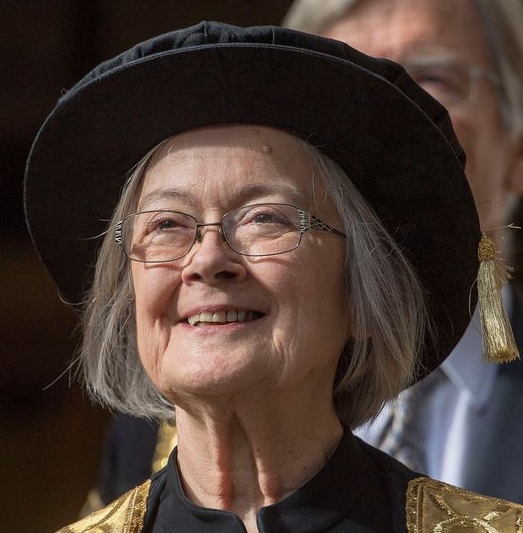
Lady Hale, a member of the Supreme Court , at her swearing in ceremony in 2017
(Manchester Evening News)

Arguably a more serious affront to democracy was the attempt by Johnson’s government in 2019 to suspend the working of Parliament which he wanted to prevent from blocking his secret preparations for a no-deal Brexit. Defeated on successive occasions in the House of Commons, Johnson attempted to shut down Parliament for five weeks. The Speaker, John Bercow, described this as a ‘constitutional outrage’; the First Minister of Scotland, Nicola Sturgeon, characterised Johnson’s actions as those of ‘a tinpot dictator’; meanwhile several thousand demonstrated outside Parliament against this suspension.

The prorogation received a legal challenge (Gina Miller v Prime Minister) and was taken for final decision to the Supreme Court. The Court’s judgement was that the Prime Minister’s advice to the Queen was ‘outside his powers’; that prorogation would have the effect of frustrating Parliament’s constitutional functions, and would have an ‘extreme effect on the fundamentals of democracy.’ Moreover, the Government had ‘provided no adequate justifications for its actions’. This Prorogation was declared to be unlawful, and therefore null and void. The question as to whether Johnson had misled the Queen was neatly avoided.

Text of the decision on Johnson’s unlawful attempt to prorogue Parliament (BBC website)

Subsequently Johnson said that the Supreme Court was wrong to pronounce on a political question, while Conservative Cabinet Minister Jacob Rees-Mogg described the judgement as a ‘constitutional coup’. On the Conservative side of the political fence, judges were seen not as interpreters and guardians of the law, but as ‘enemies of the people’; this description had been levelled by the tabloid Daily Mail in relation to another  Gina Miller challenge to the executive power. In a significant constitutional judgement, the Supreme Court had ruled in January 2017, by an 8-3 majority of all 11 Justices, that the British Government did not have the authority to exit the EU without doing so through parliamentary legislation. 

Bolstered by the electoral victory in December 2019 that gave him a strong parliamentary majority, new Prime Minister Johnson was able to meet this requirement, finally taking the UK out of the EU. But the Conservative Government has not forgotten or forgiven, and has now declared the intention to limit the powers of the judiciary to make what are described as political interventions, not legal matters. In effect, this attempts to push back hard against the constitutional principle declared in the Supreme Court judgement on prorogation: that ‘the courts have exercised a supervisory jurisdiction over the decisions of the executive for centuries’. An expert on constitutional law suggests ‘this reflects the principle of the rule of law, which dates back to Magna Carta and towards the birth of civilised, democratic society’ (J. Stanton: blogs.lse.ac.uk/politicsandpolicy/r-miller-v-prime-minister-2019/ ). Ferdinand Mount, a leading journalist and former Tory policy adviser adds ‘[Johnson] claims that this is to protect judges from being drawn into politics, but in reality it is to protect politicians from being drawn into the courts.’ ( F. Mount: ‘Ruthless and Truthless’ London Review of Books, 6 May 2021).

Clearly there is a blurred line here which in the current increasingly divisive climate will need to be clarified, and then protected from increasingly anti-democratic politicians. In my view it is over-mighty politicians who are most likely to be enemies of the people, and we need both clearer constitutional protections against them, and judges ready to police such protections. This tends to push us towards the case for a written constitution, and a fundamental reworking of our failing political and governmental institutions. This will be a recurring theme in this mini-series of posts.

Part 2 will consider the question : Do We Have A Meritocracy?

2 Comments

THE NHS NOW: REORGANISATION OR DISMEMBERMENT?

Me with my NHS tea towel from www.radicalteatowel.co.uk/tea-towels

My previous blogpost, Health In Our Time, celebrated the transformation of ordinary working lives by the Labour Government’s creation of the National Health Service in 1948. Political battles marked its inception and do so to this day. Some of these battles centre on arguments about the allocation of scarce financial resources between diverse national claims and institutions. But the overarching framework is an ideological one, with competing ideas about the role and legitimacy of that new post-war welfare state. These ideological and institutional battles were fought out both between and within the primary political parties, and the victories and defeats depended most on which particular interest had control of the levers of government. But these various competing groups were also significantly constrained by the popularity and universality of the NHS, which meant that its (mostly Conservative) adversaries treated it with great circumspection for many decades, while constantly trying to undermine it and reduce its power as a unified national institution. In the 21st century these attacks have become more strident and have coincided with a costly and aggressive health pandemic, to the extent that we might say that the NHS is currently facing an existential crisis, as calls arise yet again for its reform.

‘Crisis’ and ‘reform’ are labels that have defined debates about the NHS from the 1950s to the present day. Reform is always a weasel word in British political discourse, for it often conceals a wish and intention to destroy and replace, rather than renew and improve. I am reminded here of an old friend and academic colleague (sadly no longer with us) Professor Howard Elcock, a specialist in British local government and politics, also a sometime elected councillor for the then Humberside County Council. Mention NHS reform to Howard and you would be lucky thereafter to get a word in edgeways. He once published an article on these issues satirically entitled ‘Reorganise! Reorganise! Reorganise!’, because he could not abide the impulse of every new Government and new Health Secretary, of whatever political persuasion, to attempt a wholesale reorganisation of the health system. This normally meant in the history of NHS reform that one botched and ineffectual reorganisation would be replaced by another, with administrative and financial disarray the most common outcome. This phenomenon was most marked in the 1980s when the vogue for so-called New Public Management produced attempts to introduce competitive market principles into the processes and procedures of government, to make administrators into entrepreneurs, to create ‘smart’ government i.e., which would always be required to do more with less (less money, less staff, less state of the art buildings and technology.) A concomitant effect was to change the language of public services. In the NHS this meant treating doctors and other health service staff as ‘managers’, who must seek ‘best value’ for patients who would now be renamed as ‘customers’ or ‘consumers’ rather than ‘patients.’ Another significant effect was to reduce what was always termed the burden of taxation, deliberately subverting the notion of essential and universal public services.

This empty sloganising had little real effect when demand for health services was expanding exponentially, given that the age profile of patients was also constantly increasing. But the pressures created by these developments, both on ever-rising costs and on professional staff resources, both in primary care and in the hospital system, made the NHS vulnerable to the idea that public services of this size needed the shot in the arm that commercialisation and market principles would supply. As it happens, the first attempt to apply these ideas to  the NHS came when the Health Secretary under Margaret Thatcher was Ken Clarke, once an exact contemporary of mine at Caius College,  Cambridge in the early 1960s. Clarke’s appointment might be viewed with some irony since he has been regularly and closely involved at times with British American Tobacco, responsible for products that have caused innumerable deaths worldwide, and created heavy burdens on health services). His contribution to these burdens in 1990 was to introduce market principles into the NHS in the form of an ‘internal market’, against the advice of the medical profession.

This rushed and ill thought through reform was killed off by New Labour. But New Labour under Tony Blair and Gordon Brown made significant contributions to the introduction of competitive and privatising elements into the operations of the NHS. If the first ‘Trojan Horse’ in NHS history was Nye Bevan’s concession in 1948 that private practice could be continued within the framework of the NHS, the second one was arguably the acceptance of limited commercialisation and private sector investment under the Blair governments of 2001 and 2005, most fully realised in the Public Finance Initiative (PFI). PFI was a framework to get the private sector to fund the capital costs of constructing new public service buildings like schools and hospitals along with the long term maintenance of such buildings. New schools and hospitals were undoubtedly needed, as large parts of these public estates were old and badly rundown. PFI offered the prospect of spanking new buildings on the cheap. Taxpayers were doubtless pleased to be treated in a brand new hospital, while their children capered happily through attractive new school buildings. But the complexities of PFI contracts initially concealed undesirable outcomes: the high borrowing costs had to be met over very long periods, while long maintenance contracts were both expensive and poorly regulated. Many of our contemporary smart-looking new hospitals are still paying off considerable debts to private contractors There were even cases where the costs of paying for these new buildings and maintenance contracts meant that hospital managers could not afford the staff they needed to make them work.(we might be reminded here of the recent Nightingale Hospitals, hailed by Conservative Ministers as a brilliant piece of emergency provision, when in practice they were scarcely used ‘white elephants’ because the exigencies of the NHS meant that no trained staff were available to staff them.) James Meek sets out bluntly Labour’s responsibility: “It was Labour that introduced Foundation Trusts, allowing hospital managers to borrow money and making it possible for state hospitals to go broke….It was Labour that handed over millions of pounds to private companies to run specialist clinics that would treat NHS patients in the name of reducing waiting lists…It was Labour that brought private firms in to advise regional managers in the new business of commissioning”. Meek concludes that “If the Conservatives are dismantling the NHS, it was Labour that loosened the screws”. (Meek: 2014, pp 162-3). The dismantling soon began, first under the Conservative-Liberal Democrat Coalition government, then under subsequent Conservative Governments led by Cameron, then May, then Johnson.

The NHS Now: A Dismal Decade

NHS staff protest outside Downing Street in March 2021 (BBC images)

This might seem to be a gloomy heading, during a time when across the country, people for a time regularly came out to stand on their doorsteps and clap their hands in recognition of the heroic efforts of NHS staff at all levels to cope with the appalling pressures of the Covid19 pandemic. The Prime Minister himself would also be on the steps of 10 Downing Street, leading such applause. But this was this Prime Minister, Boris Johnson, who almost immediately denied these same staff a real-terms salary increase; a Prime Minister who has presided over a shocking array of misjudgements and delays over the past two years, and who led a secretive and possibly corrupt process of awarding to private sector companies (often linked to Conservative donors and allies) extremely lucrative health service contracts. He has refused to respond to calls from all parts of the political spectrum for an independent inquiry to ensure public accountability for many extremely ineffective appointments, and to establish that lessons are learned which could avoid serious pandemics further down the line. This is a Government which has repeatedly trumpeted claims of the world-leading nature of the British response to what is a global crisis, but almost never refers to the fact that the UK has the largest number of pandemic deaths in Europe, and in this respect is genuinely a ‘world leader’. While our research scientists have been universally praised for their work on vaccines, they have repeatedly found themselves ignored or contradicted in public decision making and management by our political leaders. These leaders cannot, of course, be blamed for the pandemic itself, and political leaders everywhere have struggled with the management of the most serious public health crisis for a century. But we in the United Kingdom have the misfortune to have, at this most critical time, the most incompetent, uncultured and self-serving set of political leaders in our lifetimes. This ineptitude is compounded by an all too apparent absence of moral compass.

Unhappily for us all, this deeply unattractive bunch have no absence of political ambition, and a major part of this ambition is to continue and extend the relentless war on the post 1945 welfare settlement that the Conservative party has waged since its initial battles with Nye Bevan. This campaign began with the Thatcher regime, whose acolytes have served in several 21st century administrations. They seized their opportunity in the dreadful Conservative-Liberal Democrat Coalition Government of 2010, when the hapless Liberal Democrats made no real effort to prevent Andrew Lansley (the Health Secretary) from getting through Parliament the 2012 Health and Social Care Act “that sent the NHS into the spiral it is now in, combining extra competition with swathes of additional bureaucracy… an attempt to realise the Thatcherite promise of marketisation” (Toynbee and Walker, 2017, p.54). From then on, health services could be commissioned from and provided by a confusing array of private and public organisations, the NHS itself just one of many possible competitors. Most NHS funding was allocated to Clinical Commissioning Groups, essentially clusters of GP practices, generally quite unfitted for financial management responsibilities, and so quickly prey to the lurking private sector consultancies that could provide such expertise.

If the Blair-Brown Labour Governments had endorsed similar (though much more carefully regulated) principles, at least they ensured a significant degree of funding, attempting to bring UK spending up to the European Union average. But the Cameron-Clegg Coalition and subsequent Tory administrations (Cameron, May) pursued an austerity financial strategy. This starved the NHS of much needed funds, and professional staffs of income increases, laying the ground for the very significant shortages of crucial health service professionals, (at all levels, but especially hospital doctors, nurses, and GPs) that now so restrict the ability of the NHS to meet rising medical need and demand. There are now 100,000 unfilled vacancies for doctors and nurses, while waiting lists stand at 6 million (Toynbee, Guardian, 23 November 2021.) A recent Institute for Fiscal Studies report predicted an increase to 11 million within a year, rising to 15 million by 2025, unless there are significant increases in NHS funding of capacity; while a Nuffield Trust study and numerous other sources warn of an existing financial deficit of £5 billion, with an increase of an extra £7 billion annually needed on top of current spending (Observer 08 August 2021). Meanwhile, as Meek predicted “the more for-profit companies become involved in the NHS, the more public money will leak out of the health system in the form of dividends’ (Meek, 2014, p.181).

While the unlamented Lansley has long gone, even darker and more dismal prospects now loom for the NHS under the Johnson Government’s crudely ideological leadership. Yet another reorganisation and ‘reform’ is being proposed under the NHS Health and Social Care Bill now on its way through Parliament (turn in your grave again, Howard!). This Bill was based initially on proposals designed by Simon Stevens, the former Chief Executive of NHS England (though before that he worked for United Health, one of America’s largest private health companies, and a major private sector global player in health services provision and contracting). The new reorganisation would replace the 2012 commissioning systems which had opened up all NHS provision to private tenders, compelling NHS bodies to compete as if in an open market. The new legislation will create (in England) 42 so-called Integrated Care Systems (ICS), each with its own budget and governing board, and intended to allow local mergers and community cooperation, while integrating the provision of local health and social care services.

But these changes (seemingly laudable in principle) are most unlikely to be realised in the face of the Government’s deliberate intention to control these new processes and institutions, and clear determination to give private providers privileged access to governing ICSs, and to increased contracting opportunities. The Bill places direct executive authority and control with the Health Secretary, a direct contradiction of the initial professes aim to give powers and control back to more localised arrangements. A major stated objective is to integrate health and social care, long advocated by health professionals and specialists. But nothing in the Bill or accompanying documentation says how this will be achieved, who will lead such a process locally, how any changes will be funded, or how private contractors, abetted doubtless by political cronies, will be prevented from cherry-picking lucrative contracts while ignoring less profitable areas of need. In short, this further reorganisation and ‘reform’ will be bent and shaped by an ideological narrative, rather than by the basic needs and imperatives of a highly prized and admired national institution, as it struggles to meet the ever-expanding health needs of a diverse and ageing population. The provisions on social care are to say the least, both opaque and controversial.

As health service users, concerned citizens, and potentially powerful voters, we need to find it in ourselves to reject the siren voices of private provision, for that way lies a fragmented health service and a two-tier system of health provision on the deeply flawed American model. We also need to be ready to accept the responsibility for ensuring adequate funding for our own preferred model. This means being ready to give our resources to support the NHS through an appropriate level of taxation, rather than haplessly lining the pockets of private enterprises who for the most part are neatly captured in the title of James Meek’s critique of the privatisation of our major public services: Private Island: Why Britain Now Belongs To Someone Else. Let’s do all we can to resurrect the fine visions of William Beveridge and Aneurin Bevan, resisting the attacks by those who are motivated by little other than self-interest.

One law for him, another for the rest of us? The Prime Minister visiting Hexham General Hospital, maskless, in November 2021

Sources

Meek, J. Private Island: Why Britain Now Belongs To Someone Else (Verso, 2014)

Toynbee, P., and Walker, D. Dismembered: how the attack on the state harms us all (Guardian Books,2017)

The Kings Fund is a highly respected independent think tank specialising in health issues. It provides invaluable detailed briefing on the current Health and Social Care Bill (www.kingsfund.org.uk)

Leave a Comment

HEALTH IN OUR TIME : The birth of the NHS

Anenurin Bevan Minister of Health on the first day of the National Health Service 5 July 1948 at Park Hospital Davyhulme near Manchester, later part of Trafford Hospital

In 1948 approximately 70% of the population was ordinary working class. An extraordinary transformation in their lives was brought about by the creation of the National Health Service on 5th July in that year. No one now under the age of 70 will have any idea of what a social revolution this turned out to be. I was 10 years old then. My parents had three children under the age of 11, including my 7 years old sister Maureen and a year old baby, my sister Sally. It is notoriously difficult to estimate and compare real wages and salaries in the 1930s and 1940s, but my farm labourer father’s wages scarcely moved much between 1930 and the year of my birth in 1937, and by 1948 still represented only two thirds of the average working man’s wage.  An authoritative history of the period judges that “labourer’s rates… were equivalent to dire poverty”. (Branson and Heinemann,1973). Most of these meagre earnings went on food, clothing and heating, leaving little for other needs such as health care.

What were these needs? The British population’s health had improved significantly in the first half of the twentieth century: my own life expectancy as a boy born in 1937 was about 60 years, but would have been only 45 years in 1900. Yet many children still died from diseases such as diphtheria and whooping cough, and even a decade later there was substantial incidence of tuberculosis. Health care provision was, writes a respected commentator on the 1930s, a thing of “hotchpotch availability, lack of funding, and reluctance to extend state involvement, all resulting in inequality of access to medical services” (Gardiner, 2011). Basic health insurance schemes, introduced in 1913, in the 1930s only covered some 40 per cent of the working population, and (crucially) did not cover dependent wives and children. Put bluntly, none of my family could afford to be sick, and we children bore the brunt of our mother’s enthusiastic reliance on a mix of old wives’ tales and the belief that we should just get on with whatever ailed us until it went away. This sort of thing didn’t work too well with then still prevalent tuberculosis, or with physical injury, twice occasioned in my case by stabbing a garden fork straight through my foot, and later when I was knocked off my bike by a lorry on our local bit of The Great North Road. Dad would then have to ride two miles on his bicycle to persuade a reluctant and somewhat patrician local doctor to leave his horse riding or cricket to come and attend to me. Paying for these visits meant hours of extra back-breaking overtime in the fields for Dad.

My parents were strong Labour supporters and were ecstatic about the unexpected Labour election victory in 1945 over the national war hero, Winston Churchill. Their faith was justified by the ensuing changes in social welfare that were so significant for poor families like mine. None mattered more to them than the introduction of family allowances, which at a stroke gave a much needed boost to their sparse income, an extra 10 shillings to add to Dad’s meagre weekly wage. But a close second was the arrival in 1948 of those free health services. Compared with today, the system was pretty straightforward: health services were comprehensive, covering everything from eyes and teeth to the most serious diseases or operations; they were universal, available to everyone, of whatever social rank; and they were free at the point of delivery, regardless of income, however expensive the treatment, and covering both hospitals and local doctoring services (this principle of free access to healthcare for all was, interestingly, confirmed by Conservative Prime Minister Margaret Thatcher some 40 years later).

These reforms did not come without a fight, waged principally between Aneurin (Nye) Bevan, my parents’ favourite political hero, and the medical profession, represented largely by the British Medical Association (the BMA). Bevan, a tough and shrewd political operator, overcame the organised resistance of this essentially middle class profession who were resistant to the notion of working as salaried servants of the state. He did so by taking advantage of divisions within the medical profession, and at the cost of conceding that hospital consultants could incorporate some private practice, well remunerated, into hospital arrangements, later to be regarded as the ‘trojan horse’ that permitted undue levels of privatisation in the health service. The Times commented at one point that “the dispute had been allowed to drag on as though it were a private wrangle between the Minister of Health and a score of elderly doctors”. Bevan had stronger words for them, “a small body of politically poisoned people” who were engaged in “a squalid political conspiracy”. A more disinterested judgement noted that “the doctors were, after all, the first middle class and predominantly Conservative interest group to offer concerted resistance to the [Labour] Government” (Jenkins, 1964).

Bevan’s determined embrace of this major reform was driven by his own bitter personal experience, his coal-miner father dying in his arms from pneumoconiosis, a dreaded pit disease, and more generally by his experience of the privations of long term unemployment in the Welsh mining valleys. My mother would never have described the Tories, as Bevan did, as “lower than vermin” but she knew well enough that the coal owners were the unyielding enemy of people like her own mining family and community in the North East and cared little about the dangerous working conditions of the miners they employed and profited from, or about the illnesses and diseases that came with the appalling housing and public health conditions that ravaged such communities.

In any case, political triumph had put the shoe on the other foot for the first time in centuries, and it was not easy for Conservative politicians and their supporters to resist the logic of 1945. Not least, these welfare reforms had been brewing for some time, underpinned by the Beveridge Report of 1942, which famously sought to get rid of the Five Giants needed to be overcome for Britain’s recovery, identified in capital letters as WANT, DISEASE, IGNORANCE, SQUALOR AND ILLNESS. (I’m somewhat disinclined to have political heroes, but Beveridge would have been one of mine). His message was that welfare reforms were needed to support national economic and social recovery, and should deliver policies that addressed poverty, income support, educational inequalities, housing needs, and health provision. The public reception of this Report was generally favourable, and it might be said that Labour’s political victory pushed at Beveridge’s open door to the creation of the welfare state. Jenkins suggests (without giving a source for the calculation) that “the whole range of services made freely available cost the equivalent of an all-round wage increase of about £2.15 shillings a week”.

The National Health Service was the centrepiece of these welfare reforms, and the response swift. Within a year, 41m people (95% of the eligible people) were covered by it. In that first year, 8.5 m dental patients were treated, and 5.25 m spectacles were dispensed. In the same year 187m. prescriptions were issued by 18,000 general practitioners. The NHS became the second largest institution in the country, second only to the armed forces. It was here to stay, and for many decades would hold a place of unusually high public esteem for a state institution. But in the last part of the twentieth century and into the present day, it would become a political battleground, fought with increasing acrimony. I’ll examine this in a second part to this blogpost. For now, I want to show what this most gargantuan and most revered of our public service institutions has looked like to one person in practice over the years, in keeping with the principle followed in my family memoir to use personal stories to support and illuminate general social and political contexts. (See Shifting Classes in Twentieth Century Britain: From Village Street To Downing Street.)

The NHS at Work: Flying High in Herefordshire                          

Our house, built 300m above sea level in the Welsh hills: I fell from the level of the first floor.

For the past two decades I have lived with my wife Sarah up a steepish hill above the Welsh border town of Knighton, a place where you can actually stand with one foot in England, and the other in Wales. Sarah planned, designed and managed the building of a delightful environmentally friendly house, mostly of wooden construction (see photo). We pretty much lived ‘on site’ for long periods, and at one point moved into the upper floor of the half-completed building, our sleeping accommodation reached by a single ladder. Early one Sunday morning I went to climb down the ladder. The ladder suddenly began to slip away from underneath me, and I was flung backwards, landing on my head and shoulders onto the hard concrete floor some 12 feet below. I lay there half conscious, head bleeding, utterly unable to move, this the first act in a protracted drama of which I have only the haziest recollection. Sarah can’t even remember how she managed to get down to the floor without a ladder but somehow managed to summon assistance. This came in two forms, first a local ambulance , but more dramatically a Welsh Air Ambulance helicopter, which swooped from the sky into the field next to us. It would be my one and only helicopter flight and I never saw a thing…

G-WASC - Wales Air Ambulance Eurocopter EC135 (all models ...
One of the fleet of Welsh Air Ambulance helicopters, similar to the one that flew me to Hereford. An invaluable lifeline for serious emergencies in remote rural areas, the service is funded by charitable donations.

Since a broken neck or back was suspected, I was strapped into a head brace, and flown (in a matter of minutes) to Hereford Hospital: here I was met on their landing pad by a consultant surgeon hauled away from his Sunday morning breakfast. Satisfied after x-rays that nothing was broken, just rather badly battered, he consigned me to more junior hands and made off. I never saw him again. I was given a serious number of painkillers which rendered me more or less comatose for a few days. When I came to enough to survey my new surroundings, I found myself in a bed in a single room, cut off from the rest of the orthopaedic ward. I was propped up in sitting position, scarcely able to move, my neck still encased. Since I rarely slept much at night, I was at least entertained by a series of noises off, many being calls from patients who wanted a nurse to attend them. Many of these calls were disregarded, which shocked me at first, not least because in these initial 72 hours a nurse inspected me regularly, presumably in case I deteriorated in some way. I was by this time a no-neck monster, my neck and upper vertebrae swollen into a sort of flabby football.  The friendly nurse reassured me that “it’s always like this at night, if people can’t sleep they think they need constant attention, a bit like overgrown children, best left to get on with it”. I saw the sense of this, but was a bit perturbed by some poor chap who was clearly feeling in despair, and cried out regularly for divine assistance. Getting no answer, it seemed, he would shout quite loudly and repeatedly: “Where’s God when you need him?’ Reply came there none, not even from the nursing staff.

A different diversion was provided by an elderly lady who had recovered from some kind of operation. Because she was also suffering from dementia, and normally lived alone, she often wondered out loud what all these people were doing in her home? She regularly invaded the nurses’ cubby hole where they could relax a bit, crying ‘Get out of my kitchen you hussies!’ The nurses were remarkably kind and tolerant of her, knowing that her mental affliction was as great as any physical problem she had; she could not return home as a suitable social care package was unable to be accessed. She would be known, statistically, as a ‘bed-blocker’. She occasionally looked in on me to pinch my morning toast, left at the bedside by the harassed staff, but well beyond my reach.

What struck me most about this spell in hospital was how many different people would have to deal with you in some way, each trying to solve some problem you presented for them. At the top of this food chain, I would occasionally see two house doctors, one Dutch, the other a Nigerian, attached in some sort of training role. Both were friendly and reassuring, mostly concerned to monitor my pain management medications. My main problem here was that I had been installed in a specialist bed, meant to be ‘smart’ enough to adapt to different positions in which I had to be held at different times. Unhappily, a crucial bit of the smart mechanism seemed not to be working, which meant that I was in considerable discomfort at times, especially at night. The first attempt at a remedy came in the form of a technician, who poked around in the bed’s electronic entrails, then surfaced to tell me the good news: a crucial new part would solve the problem. Lugubriously, he followed with the bad news: it was not available in the hospital and unlikely to be obtained for several weeks. My saviour at this point was the senior nurse in the department, who said that what I needed was a new bed. She disappeared, to return red-faced but smiling broadly, and wheeling another smart bed: “It was just lying around in General Surgery” she said “and nobody seemed to be using it, so I’m swapping it for yours”.

This was typical of the nursing staff, harassed but determinedly ‘can-do’ when faced with problems, cheerful and attentive despite the myriad claims on their time and skills. I can only record one instance where this was not the case. As the doctors encouraged me towards some sort of mobility I could walk gingerly to the toilets in case of need, but I had to be helped out of bed, and back in again. The procedure was for me to ring a bell for the duty nurse. Normally all would be fine, but on this occasion, the rather pursed-lipped nurse who answered the call made no move towards me.  I explained that because of my injuries I needed to be helped out. The lips pursed even harder: “Well, I can’t do that for you,” she said triumphantly “I have a bad back”. But this was the exception that proved the rule, and I have nothing but praise and gratitude for the care and kindness I constantly saw on display in this Herefordshire hospital at this time. When I limped out after three weeks, supported by the two East European physiotherapists who had been devoted each day to helping me to find my own, rather unsteady feet again, I felt that the whole place had seen me through an unexpected crisis and had helped me to face the world again.

The NHS At Work: Coming Down to Earth Again in Manchester

Since my home then was in Manchester, I was returned there to continue my treatment. By chance, the first hospital that could give me a consultation was Trafford Hospital, the very place where Nye Bevan had formally launched the NHS in 1948 (though then designated as Park Hospital, Davyhulme: see photograph at beginning of blog). Like Hereford, it was showing its age, with many buildings in need of repair or replacement. They were not too keen on this cuckoo thrust into their nest from a distant hospital, and I was glad when I could be returned to the care of my own local hospital, South Manchester University Hospital, regarded as a leading NHS institution. As a result of my neck and head injuries, I had been experiencing spells of dizziness and poor balance, which could have had a range of physiological and neurological causes. They had just the place to deal with this: the Department of Elderly Medicine, a title that still makes me smile, but left me a little miffed, too, seeing myself as a fairly fit and youthful person who just happened to have fallen on his head. This perception appeared to be shared by the assembly of patients in the consultant’s waiting room, all quite manifestly halt, lame and aged. As I strode purposefully and vigorously from the consultant’s office, the resentful expressions of those waiting their turn clearly showed their disbelief: how could I possibly have need of Elderly Medicine?

What followed for me was an intriguing journey through several medical departments and units, even other hospitals, as they sought to determine what my problem was. The first port of call was the Neurology Department, who organised a brain scan (when I asked if I should worry about drinking alcohol, a rather lofty consultant advised me to Consider My Habit, something which I have been doing ever since). A second consultant, seeking I think to impress a visiting Chinese surgeon who was sitting in, lectured me on Occam’s Razor, implying that where there could well be several causes of my condition it would be best to assume it could be any of them, and take no further action. My next visit was to the Professor of Rheumatology, clearly highly qualified as to his specialism, but with a rather idiosyncratic pronunciation of English. He wished to examine my fingernails, and was clearly excited by what he saw. “Look,” he enjoined me “Cirrhosis!” I was horrified; clearly I had not sufficiently Considered my Habit, and it was coming back to bite me. Bemused, I asked how he could tell? As he talked, I suddenly realised it was the pronunciation at issue here, not my liver: “Ah! You mean PSORIASIS”. “Yes! Yes!” cried the Professor enthusiastically “Cirrhosis!” We parted on extremely amicable terms of mutual misunderstanding.

Next up was the Heart Department. First I had to undertake a series of very energetic running and walking tests, attached to several machines and gadgets. Then I had what would be my most memorable experience, when my heart was examined through a sort of superior X-ray instrument which meant that I could see the resulting pictures of my own heart, pulsing and beating. I was fascinated and I could hardly tear my eyes away. I was assured that my heart was in excellent shape, and indeed I could see and hear that for myself: a spell-binding moment.

A further compliment followed when I was sent to the Salford Royal Hospital to see a specialist who would run the rule over a batch of x-rays of my neck, spine and pelvis. He was brimming with enthusiasm: “Look! You have an absolutely perfect pelvic girdle!”; well, yes, doctor, but why is it hurting?

This extended journey through most of the pathways of ‘elderly medicine’ left me feeling better about myself but not really much the wiser as to the prognosis for my condition. The Elderly Medicine consultant, a spry 50 or so, walked five miles to the hospital to keep my (and other appointments) when roads and transport were blocked by heavy snowfalls. Cheerfully rosy-cheeked he told me “the body has a long memory”, and he could see no reason why mine should not simply, in the long run, remember again how to walk and balance properly. And indeed it did, over the next decade, a period over which I permanently avoided ladders, as well as carefully Considering My Habit.

I could add many more stories of this kind, as the NHS sought to keep its explicit 1948 promise to see me through from the cradle to the grave. I have had successful operations on both knees, on a malfunctioning eye, effective hospital treatments for food poisoning, problems with my bowel, and twice for broken bones. A succession of general practitioners, unrestricted by horse riding or cricket, have shepherded me through a host of the usual minor ailments. Hospital emergency departments have set the broken noses of two sporting sons. At various times I have taken a lot of pills. In the last two years I have been protected by vaccinations from the appallingly dangerous Covid19 pandemic. The great majority of British adults will have had similar experiences. I feel strongly, then, that over my and many other people’s lifetimes the promises of 1948 have in many ways been honoured, but are increasingly under threat, as my next post will argue.

The NHS: Back To The Future

A lot of political water has passed under the health service bridges since 1948. Often this was because governments have consistently wrestled with the ever-rising costs of keeping those 1948 promises: this caused a convulsion in the Labour Government of 1950-51, when Nye Bevan himself resigned over the move to impose charges for what had been until then free spectacles and dental treatment (accompanied by Denis Healey and Harold Wilson). Bevan unsuccessfully resisted the breach of his prized principle of an entirely free service. But in 1951 the costs of the NHS were already around three times the initial estimate in 1946 (Peden,1985). The battle to balance rising provision with scarce resources has scarred the political landscape ever since. This landscape has been shaped by political ideology too, as Conservative administrations have sought relentlessly to overturn the post war welfare contract between state and citizen. I’d need to write a book to deal with this properly and many people have done so. I’ll use some of these commentaries in Part 2 of this blog to attempt to answer the question: Why Is The NHS a Political Football and Who Is Winning?

Sources of Information

Gardiner, J. The Thirties: An Intimate History (Harper Press, 2011 edition)
Glennerster, H. British Social Policy Since 1945 (Blackwell, 1995)
Hennessy, P. Never Again: Britain 1945-51 (Jonathan Cape, 1992)
Hennessy, P. Having It So Good: Britain in The 1950s (Penguin, 2007 edition)
Jenkins, P. 'Bevan's Fight With the BMA' in Sissons, M. And French, P. Eds., Age of Austerity 1945-51 (Penguin, 1964 edition)
Minogue M, Shifting Classes in Twentieth Century Britain: From Village Street to Downing Street (YouCaxton Publications 2020 see www.youcaxton.co.uk) 
Morgan, K.O. Labour in Power,1945-51 (Oxford University Press, 1985 edition)
Peden, G.C. British Economic and Social Policy: Lloyd George to Margaret Thatcher (Philip Allan, 1985)
Pugh, M. 'We Danced All Night': a Social History of Britain Between The Wars, chapter 3 on 'Health and Medicine' (Vintage Books, 2009)
1 Comment

AGAINST CHURCHILLIAN NOSTALGIA

Sir Winston Churchill statue (photo credit Stephen E, Pixabay)
Two vast and trunkless legs of stone
Stand in the desert. Near them, on the sand
Half sunk, a shattered visage lies, whose frown
And wrinkled lip, and sneer of cold command
Tell that its sculptor well those passions read

My mother’s two favourite poets were Byron and Shelley, and this extract from Shelley’s Ozymandias pretty well sums up her views of her least favourite politician, Winston Churchill. Here was another hero turned villain (or perhaps villain turned hero), yet more statues with ‘feet of clay’ (see previous blogpost). ‘Churchillian’ values are rather freely and inaccurately proffered to us just now by our bombastic Prime Minister, Boris Johnson. No hero he, just clay all the way through, and a woefully inaccurate and self-serving historian of Churchill to boot. Conventional historical accounts of Churchill tend to lionise him. A recent Channel 5 documentary on Churchill, interesting because it deployed substantial personal and family archives, gives an exceedingly partial account by glossing over many of the events that do him little credit: Churchill’s role in supporting the use of the brutal and infamous British military ‘Black and Tans’ as a virtual terror gang in Ireland in 1920; his strong opposition to women’s suffrage; his gleeful encouragement of a type of real class war during the General Strike of 1926; his dismissively racist attacks upon Mahatma Gandhi and the whole notion of Indian independence; and his utterly shameful 1945 election claim that Labour, led by the man, Clement Attlee, who contributed so much to Churchill’s successful prosecution of the 1939-45 war, would, if elected, behave like the Gestapo.

My mother could tell you about any of these glaring faults, but was most angered by the attacks on working class miners by a man born into privilege and preferment. She didn’t have a good word to say for him, even less for the mine-owners who were his natural class allies: as an Historical Association pamphlet about the General Strike of 1926 by Margaret Morris puts it: ‘no-one has ever had a good word to say for the coal-owners and their leaders’. Moreover, the bellicose Churchill had disseminated accusations that Soviet style unions were trying to take over the country, a sort of ‘red peril’ scare; yet many of the men marching in protest at their abysmal working and living conditions were seen to be wearing their war medals. Churchill had already shown his aggression to ordinary workers when in 1910, as Home Secretary, he sent in the military to put down a miners’ strike in Tonypandy in Wales, and he again responded with force to the strike by protesting transport workers in Liverpool in 1911. Mum was nothing if not a class warrior, and she had not forgotten or forgiven these slurs and enmities.

The rejection of Churchill by the British electorate in 1945 was not just a shock to Churchill himself, but to the many people for whom he was a war hero, ‘the greatest living Englishman’. In 1963 I was staying with a well to do German family in Hamburg. They might have been excused for being hostile to a man who had presided over the brutal firebombing and virtual destruction of their beautiful city, with the loss of some 67,000 lives, most of them civilians. But no, they were partly Jewish and generally pro-British. A family Aunt Gisela, who had excellent English, demanded an explanation from me: “Why? Why? How could your country behave in such a way, voting against the leader who had won the war for them? We were deeply shocked by this, Winston Churchill was our hero too. We just did not understand this.”.

Well, people like my working class parents understood all too well. Churchill had been a brutal and aggressive class warrior for most of his political life, and the ruling class he represented and had been born into (in 1874 in Blenheim Palace, home of his adored ancestor, the Duke of Marlborough). With this pedigree it is perhaps unsurprising that he would show little sympathy for the working classes who had suffered grievous blows not only in the First World War trenches, but in the economic depression that followed in a land that was certainly not fit for heroes. The children of that generation, like my own parents, were shaped by the privations their families had suffered then, and in the often depressed 1930s. They did not intend to let the same story be repeated again and took their political revenge once the 1939-45 war was safely over.

Churchill was not unused to political reverses, for if you leave aside the glories of successful war leadership in 1939-45, his political career is littered with mistakes and mismanagement, and betrays a volatile and unstable temperament. He had few clear political principles, rather a set of knee jerk responses based in the fundamental beliefs and values of his patrician class and time, that would become increasingly anachronistic. Doubtless fearful of what he discerned as a real threat from rising working class militancy, he was quick to see communism and revolution around every social and political corner. An academic failure, and probably damaged by a deeply flawed relationship with his cold and bullying father, Lord Randolph Churchill, he sought an early escape into imperial soldiering. This background may have accounted for the militaristic rather than diplomatic impulses which would characterise so much of his political life. Quickly realising what a dead end a military career might be (and fundamentally how boring), he turned to politics, where easy preferment offered easier pickings. In the complicated politics of the end of the nineteenth century, after an initial flirtation with the Conservative Party as MP for Oldham, he switched to the Liberal Party as the likeliest ladder to success at a time of declining Conservative Party fortunes.

I owe to my cousin Tom Minogue the sources for a fascinating glimpse into Churchill’s early political life, in the form of an article in the main Dundee newspaper, The Courier, assessing Churchill’s 14 year reign as Liberal MP for Dundee from 1908 to 1922. The respectable burghers of Dundee no doubt were glad to have this modern Vicar of Bray as their representative in Parliament, someone actively influential at the highest levels of government, even though he was seldom to be seen in Dundee except at election times. But he would often meet a less welcoming response lower down the social scale. Early on he aroused the ire of suffragist supporters, one of whom, Mary Malone, regularly protested at his election meetings about Churchill’s clearly expressed opposition to votes for women; she would ring a large hand bell to drown out his speeches. Later he would lose much support from ordinary workers for his anti-union actions while Home Secretary, for his dismal failures while First Lord of the Admiralty during the Great War, and not least for his perceived antagonism to the Irish and Home Rule: indeed in 1921 the Dundee Catholic Herald described him as ‘a dangerous, double-dealing, oily-tongued adventurer’. It was said that in the 1921 election, suffering from ill health after appendicitis, he had to be carried around in a sedan chair, and that while locals were paid £1 per hour to do this, they were offered £2 by their fellow workers to drop him. Perhaps it is no surprise that he finished fourth and last in this election. He quipped that he left Dundee “without an office, without a seat, without a party, and without an appendix”.

This period seems to sum up all Churchill’s personal contradictions and shortcomings, even though he enjoyed several ministerial positions, and increasing political prominence. In his first (junior) ministerial post, as an Under Secretary for the Colonies, his most notable claim was to have shot a white rhinoceros in Uganda. His equally aggressive actions a few years later as Home Secretary left organised labour with a deep-seated and long standing distrust of him. Given his eventual success as a war leader it may seem surprising how inept he was as First Lord of the Admiralty during the 1914-18 War, aggressively pushing his ambitious but poorly conceived pet project for a naval campaign against Turkey. This ended with disastrous defeats in the Dardanelles. The failure of the initial naval attack was not entirely surprising, as some of the ships were obsolete (HMS Indomitable and HMS Indefatigable proved anything but, though HMS Inflexible may have lived up to its name). In the subsequent, much delayed military invasion, hundreds of thousands of casualties resulted. Prime author of this inglorious defeat, Churchill had to resign, and decided to take an active military role in the war, spending several months on a quiet part of the Western Front; becoming bored, he wanted to return home but his wife Clementine told him in a stern letter to stay where he was, it would look bad if he were to scuttle back home too soon.

On returning to active politics, Churchill held relatively minor positions in the Lloyd George coalition, but as Colonial Secretary had fingers in several pies, though his interventions have not been well regarded. He had always strongly opposed Home Rule for Ireland and was always prepared to use force, but at this time largely had to take a back seat to Lloyd George. In the Middle East, a disturbed part of the Imperial framework in the post-war period, he oversaw that artificial creation of Iraq which would cause endless future problems, and advocated the use of gas war against local insurgents (a precedent that would be followed by Saddam Hussein in due course). And as a committed pro-Zionist, he also supported the creation of a Jewish homeland in Palestine, regardless of the claims of indigenous Palestinians.

On the resignation of Lloyd George in 1922, and the loss of his Dundee seat in Parliament, Churchill (after three unsuccessful attempts to win a Liberal seat) flipped politically again in 1924 to Baldwin’s Conservative administration, nominally holding the seat of Epping as a ‘Constitutionalist’. He was given, to general surprise, the Chancellorship of the Exchequer; to no-one’s surprise he made a hash of this job too. His controversial decision to return Britain to the Gold Standard proved deeply damaging, exacerbating economic depression and seriously damaging the coal industry (John Maynard Keynes wrote a critique in a pamphlet titled The Economic Consequences of Mr Churchill.)

The political consequences of Mr Churchill thereafter scarcely improved his reputation, or his standing with ordinary working people. The economic effects of his financial decisions led on directly to the General Strike of 1926, a situation which brought out all Churchill’s worst instincts, treating Britain’s trade unionists as if they were revolutionary enemies of the state. Enraged by the unions’ ability to close down newspapers, he proposed the publication of a Government newspaper, The British Gazette, and did his utmost to control the content. Much given to informal editing, he often slipped in inflammatory comments. He also insisted on the printing of deliberately falsified information (which current politician and former journalist does this remind you of?) and refused to print a statement by the Archbishop of Canterbury and other religious leaders that called for a negotiated settlement. He even contrived to arouse opposition from King George V, for what the King thought were blatant incitements to violence. Lloyd George pronounced that the Gazette was “a first class indiscretion, clothed in the tawdry garb of third rate journalism”. Undeterred, Churchill continued incendiary calls to class warfare, which encouraged scores of middle and upper class undergraduates to volunteer to take the place of striking railway men and bus drivers. Churchill described the journal as ‘a monument’; the New Statesmen in May 1915 said “it was a disgrace alike to the British Government and to British journalism”.

Once the General Strike collapsed, after a mere nine days, the miners continued to strike for another six months, but were defeated by a combination of uncompromising owners, their own internal divisions, and a recalcitrant Government not disposed to make concessions. It was a bitter outcome. Looking at recent accounts, I’m inclined to think that Baldwin is more to be castigated than Churchill for the failure to take on the abysmal coal owners. But I’d have had a hard task to persuade my Mum and Dad of this. Mum’s view of Churchill as ‘Class Enemy Number One’ was only reinforced by her perception of Churchill as ‘Women’s Enemy Number One.’ Churchill had always set himself against conceding the vote to all women, on equal terms with men. He made his attitude clear by telling Parliament that “women were represented by their fathers, brothers and husbands”. He probably feared the electoral consequences of universal suffrage, which lead him in the 1924 Conservative Government to argue strongly against going any further than the limited reform of 1918. And probably he was right, because after the full extension of suffrage in 1928, the Conservatives were defeated in the election of 1929, bringing in Labour for a second term of minority Government under Ramsay MacDonald.

A final charge against Winston Churchill would have to examine what historian Eric Hobsbawm describes as his “diehard imperialism, of which Churchill made himself the spokesman”. Perhaps this is unsurprising, given his birth into an aristocratic elite at a period when Victorian imperialism was at its height, and his early experiences as a soldier fighting in overseas countries to defend imperial power and territory. But his nineteenth century attitudes rapidly put him out of touch with most of his political contemporaries in the 1930s, and fractured his relationship with Baldwin. He campaigned strongly for the retention of the existing British Raj, and openly sneered at India’s most admired activist, Mahatma Gandhi : “It is alarming and also nauseating to see Mr Gandhi, a seditious Middle Temple lawyer, striding half-naked up the steps of the Vice-Regal palace”. We might recall that Churchill strongly resisted the notion that either the Irish or the Indians were fit to govern themselves. Yet thousands of both Indians and Irishmen died fighting for Britain in both World Wars, something that seems to have escaped Churchill’s attention. Notoriously, Churchill refused to provide emergency food relief during the Bengal Famine of 1943 that killed 3 million Indians. His own Secretary of State for India, Leopold Amery, wrote that “Churchill knew as much of the Indian problem as George III did of the American colonies.”

My mother told me once that during the Second World War my strongly Labour father patriotically had a photograph of their war leader on the wall, against her wishes. In 1945, Dad would not take the photo down, despite her urgings, but he compromised by turning Churchill’s face to the wall. This seems to me a reasonable judgement of the whole of Churchill’s career, shot through with occasional brilliances, but besmirched by desperately poor judgements and errors, most of them egregious, sometimes costing thousands of lives.

I set out to write this blog to balance a previous analysis of Labour heroes with feet of clay.  But I also had in mind the way in which the present British Prime Minister, Boris Johnson, consistently invites us to celebrate British heroes, specifically Winston Churchill, a politics of nostalgia that seeks to divert our attention from present failures. Nick Cohen, in The Observer recently, writes that “modern Conservatives are a brothel-keeper’s nightmare: they can never identify the fantasy they want to act out”. Note how often Johnson and his political colleagues use the adjectives ‘world-leading’ and ‘world-beating’ to describe British achievements. This narrative of ‘greatness’ is all too often a political and historical misrepresentation, whether of countries or of men and women, and part of that misrepresentation is to ignore the necessary contribution that ordinary people will have made to whatever glories and successes are being paraded.

I want to be fair to Churchill, though Mum would have snorted derisively at this: whenever were that lot fair to me?  In my judgement, he was for the greater part of his long and active political life a failure, often acted like a political opportunist, and was too often driven by personal political ambition. He had serious character flaws. Yet these flaws could also be a strength. At the point in the 1930s where our national survival was at issue, an aggressive war leader was exactly what we needed. And he was exactly what we did not need once the war was over. His final Prime Ministership in the 1950s was a sad and disillusioning affair, the colossus brought low by drink and illness:  Roy Jenkins described him as “gloriously unfit for office”. In June 2019, when Boris Johnson was prospective leader of the Conservative Party, but not yet Prime Minister, his old boss as Editor of The Daily Telegraph, Max Hastings, echoed this description, declaring him as “unfit for national office, because it seems he cares for no interest save his own fame and gratification” and presciently suggested that if he became Prime Minister he “could survive for three or four years, shambling from one embarrassment and debacle to another, of which Brexit may prove the least…he supposes himself to be Winston Churchill, while in reality being closer to Alan Partridge.”

He characterised Churchill as “a profoundly serious human being”, Johnson as a morally bankrupt “cavorting charlatan”. My own view, expressed in this post, is that Churchill and Johnson have more in common than Hastings would be likely to admit; that in the past hundred years or so we have had more than our fill of arbitrary and contemptuous political leaders, and need constantly to be on the alert for and resistant to the current versions. We should all beware that “sneer of cold command”.

Winston Churchill and Aristotle Onassis Sir Winston Churchill with cigar still burning, nods as if having a sleep, on board the Yacht “Christina” owned by Greek shipping magnate Aristotle Onassis, at Cartagena, Spain, Sept. 28, 1958 during his current Mediterranean Cruise. Onassis shown at right. (AP Photo)
2 Comments

POLITICAL HEROES WITH FEET OF CLAY


Photograph of Labour Prime Minister Ramsay MacDonald with Margaret Bondfield, the first female member of the Cabinet and Minister for Labour in the government of 1929–31 (source: The National Archives)

The photograph above shows two leading Labour Party politicians of the 1920s and 30s. For my mother, daughter of a miner in the North East of England, and someone with strong and passionate political convictions, one of these was a hero, the other a villain. You might have expected Ramsay MacDonald to be the hero, as first ever Labour Prime Minister, even if this was in a minority government in 1923-1924. But MacDonald seriously divided the Labour Party by joining a coalition National Government in 1931, after the collapse of his struggling and chaotic second minority Labour Government of 1929-31. Margaret Bondfield was Minister of Labour in that government, and the first woman ever to be a Cabinet Minister in Britain, just as in 1923-1924 she had been the first woman ever to hold a governmental position, as a Parliamentary Under Secretary. (The first woman to take a seat as a Member of Parliament was the upper class Nancy Astor, sitting as a Conservative).

Margaret Bondfield was initially known for her grass roots initiatives (around the turn of the nineteenth/twentieth century) in organising and helping to unionise shopworkers – overwhelmingly women – and bringing their union, the National Amalgamated Union of Shop Assistants, Warehousemen and Clerks, into the ambit of the nascent Trades Union Congress. She memorably declared that she ‘had no vocation for wife-hood or motherhood, but an urge to serve the Union’. Initially a young shopworker herself, she did sterling work in recording the appalling working hours and conditions of this part of the working class, and campaigning for reforms to these conditions and associated low wages. She was already, in 1899, the first woman delegate to the Trades Union Annual Congress. It was this experience and background that made her a natural candidate for political office in the Ministry of Labour, in both of the first two Labour Governments.

By that time, in 1930, my mother was learning the hard way about the similar oppressively long hours and low pay associated with being a domestic servant in a rural aristocratic household. This would seem to make her an unlikely candidate for political activism, but she came from a mining family in Wallsend, that had lived through and suffered from the long aftermath of the 1926 General Strike. This experience left thousands of such mining families bruised and embittered by their ultimate defeat at the hands of the uncaring coal owners and the Tory Government supporting them. In 1926 Margaret Bondfield became the MP for Wallsend, winning this seat again in 1929, so a natural focus for my mother’s admiration.

Strikingly, Mum’s political feelings were captured more exactly by the travails of the suffragette movement. The divisions in this movement are well known; the Women’s Social and Political Union (WSPU) under Emmeline and Christobel Pankhurst used violent protest methods but were ready to settle for a limited franchise based on age and a property qualification. The Adult Suffrage Movement were bent on gaining suffrage on equal terms with men, without any limitation. Margaret Bondfield was very active in this organisation, arguing that a limited franchise was of no benefit or interest to working class women. The limited reform passed in 1918 enfranchised all adult males, but restricted voting rights to women over 30, and property owners or wives of property owners. This brought in 8.5 million new women voters, which may have helped Labour to win minority government in 1923-4. But the Tory Governments from 1924-1929 resisted more radical change until 1928. It is thought that Winston Churchill, bolstered by his 1926 victories over the workers, used his influence behind the political scenes to prevent this reform, fearing that working class women would overwhelmingly support Labour. As indeed, in 1929, they clearly did, with the addition to the electorate of another 4 million new women voters, and women now a majority (52%) of that electorate.

This brings us to J. Ramsay MacDonald, initially lionised as the first Labour leader to form a government, if a minority one. The Conservatives under Baldwin had quickly resumed what they considered their rightful place, but were damaged by internal divisions and a rapidly worsening economic and social crisis, to be known as the Great Depression. In1929, McDonald led the Labour Party into another minority Government. But, as seems so often to be the case with the Labour Party over the twentieth century, this would prove to be a pyrrhic victory. The new government struggled to manage the economic and social crises of the early 1930s, unable to resolve how to meet the costs of rising unemployment and related benefits. Few Labour ministers came through this baptism of fire with much credit. Ministers with genuine working class credentials, like J H (Jimmy) Thomas, and Margaret Bondfield too, proved to be out of their depth, particularly unable to make an impression on unemployment and related social benefits, the one area where their supporters might have expected better; indeed, Margaret Bondfield’s reputation was forever clouded by her willingness to support cuts in benefits and stricter rules on entitlement.

Worst of all, Ramsey Macdonald turned out to be a busted flush, presiding over a chaotic administration and deeply divided party. He was all too ready to respond to siren overtures that projected him as, in effect, the figurehead of a national ‘coalition’ dominated by Conservative members. Only four of his Labour Cabinet went with him into the National Government and the rest withdrew to lick their wounds. Inevitably, Labour lost ground badly in the 1935 election. Only would eventual world war restore some influence through those Labour leaders regarded as capable of playing a full role in a genuine wartime coalition under Winston Churchill. Beatrice Webb had presciently seen through MacDonald’s blithe exterior in 1926:

He is no longer intent on social reform – any indignation he ever had at the present distribution of wealth he has lost; his real and intimate life is associating with non-aristocratic society, surrounded with the beauty and dignity which wealth can buy and social experience can direct. Ramsay MacDonald is not distinguished either in intellect or character, and he has some very mean traits in his nature.

Beatrice Webb:  Diaries, 1924-1932

Definitely an idol with feet of clay, and perhaps this is also true of Margaret Bondfield. Passionate Labour Party working class supporters like my parents were outraged by what was regarded as a betrayal by Ramsay MacDonald, and so described at the time by a young Ernest Bevin.

In my memoir Shifting Classes, I recall an incident in 1963 when I was working as Resident Clerk in the Commonwealth Relations Office. My opposite number in the Foreign Office was Kenneth Scott, and we often met to have drinks in each other’s flats, rather grandly overlooking St James’s Park and Buckingham Palace. My mother happened to be visiting me, and Ken Scott insisted that he would entertain us both. Ken always had a fund of stories about past politicians and their private secrets. He regaled us with a tale of Ramsay MacDonald, whilst PM, going missing in a serious international crisis because he was shooting on some aristocratic estate in Scotland and could not be reached. Mum was outraged all over again and entertained this young Foreign Office grandee (he would end a distinguished ambassadorial career with a knighthood) by her strongly expressed disdain for this once loved leader who had cynically betrayed the working class that had originally voted him into office.

She was in no better humour when I told her that at work, I had recently met Ramsay Macdonald’s son Malcolm, who as Governor General of Kenya had played an advisory role in relation to the recent negotiations for Kenyan independence. (After following his father into the National Government, son Malcolm had followed a political career in successive pre-war administrations, and then in Churchill’s wartime coalition, before pursuing a more diplomatic career in colonial affairs.) It was, I think, the feelings of class denial and betrayal that so alienated people like my Mum and Dad from these erstwhile leaders and heroes.

Doubtless we all have our favourite heroes, some of whom turn out, like the examples above, to have ‘feet of clay’. Many Labour supporters now would probably place Tony Blair in this category. But there are significant Conservative heroes with feet of clay too, and in my next blog I will turn my attention to Winston Churchill.

Leave a Comment

ALL THE WORLD’S A STAGE

Desmond Gill: left in 1987, centre, as school Hamlet 1959, right as Titus Andronicus, Birmingham Repertory Theatre 1963
 All The World's A Stage
 And all the men and women merely players
 They have their exits and their entrances
 And one man in his time plays many parts. 

These lines from Shakespeare’s As You Like It seem apt to the business of what is referred to in literary circles as life writing. A memoir will have a cast of characters, some heroes and some villains, there will be some funny bits and some grim bits. As for the playing many parts, a significant motif in my own memoir, Shifting Classes, is the way in which you experience multiple identities as you transition between different social levels, and find yourself consciously playing out different roles. During the period covered by this family memoir, approximately the first six decades of the twentieth century, social relationships were strongly shaped by levels of class consciousness that would seem absurd to many people now, except that social differences are still strongly marked today and seriously determine life chances.

Early Dramas

In a following post I’ll discuss how this applies in the theatrical world, but for now I want to recall the various ways in which I was drawn into the world of make believe that is theatre. Readers of the memoir (Chapter Three: First Footsteps) will know that a tongue-tied performance at the age of five, induced by my first ever sight of a real audience, was received with such loud laughter and applause that I was hooked on the stage for life.

The next opportunity came at my northern grammar school, King James’s Grammar School, Knaresborough. Two wonderful drama teachers, Molly Sawdon and Paddy Wansbrough, produced some outstanding productions, and squeezed some remarkable performances from their stolid Yorkshire charges. But some of them were not so stolid either and would go on to professional careers in the theatre, including the Shakespeare Memorial Theatre at Stratford, the Royal Court in London, and leading repertory companies in Birmingham, Bristol, Liverpool, Nottingham and Leeds. One of my school contemporaries, Desmond Gill, was also from a farming background. Participating in these school productions soon made him realise that acting was the only thing hereafter that he wanted to do. His finale at school was an astonishing Hamlet, which won an admiring notice from a knowledgeable critic, John Rathmell, a former pupil who was now a Fellow of Jesus College, Cambridge, and capable of quite trenchant judgements. (He had reviewed an earlier production of Christopher Fry’s free verse play, The Lady’s Not For Burning as ‘a mixture of good poetry and bad theatre’). He was swept away by Desmond’s performance: he wrote ‘This was his play, and his performance was unforgettable…the quality that made the performance memorable was a toughness beyond the range of the effete Drama School products that the Old Vic has recently presented us with’. He presciently declared that ‘if he so wished he would make his mark on the professional stage’. Desmond did so wish, and won a scholarship to RADA, graduating in 1961.

Another of Molly and Paddy’s protégés and friends was one Geoffrey Wilkinson, like Des, from a local farming family. I don’t have much information about his grammar school acting because he was at school at least a decade later than me. Subsequently, I would bump into him from time to time at the University of Kent in the late 1960s where I was lecturing, and where he not only studied English Literature, but would meet his future wife, later another leading actor, Diana Hardcastle. He would himself go on to an absolutely stellar acting career, and is best known now, of course, as Tom Wilkinson, rightly much celebrated on stage and screen.

To complete this story of one school’s exceptional theatrical connections, we might note that one Peter Dews would spend a short time in 1952 at Knaresborough Grammar School as a history supply teacher. Our resident critic had words of praise for ‘a howling success’ with A Midsummer Night’s Dream, owing much to the ‘brilliance of the producers, Miss Ellis and Mr Dews.’ This is no less than the Peter Dews who would become the innovative artistic director of the Birmingham Repertory Theatre (1965-72), after producing the outstanding and award-winning BBC series of Shakespeare’s history plays, An  Age of Kings in 1960 (and I suppose it’s possible that Des Gill may have acted under his direction  at Birmingham).

Not a bad set of theatrical ‘old boys’ for a small, unpretentious Yorkshire grammar school!

The Stratford Connection

My theatre-mad schoolteacher mentors bought a house in the Cotswolds (to which they later retired) in order to be near to the Royal Shakespeare Memorial Theatre at Stratford. Visits to them would always include marvellous theatre treats, including (in 1969) a young Judi Dench as an unforgettable Viola. In the early 1980s Anthony Sher rented a cottage from them in Chipping Campden while playing Richard III. John Wood, already famous, was a nearby neighbour and friend, and would occasionally appear with his wife at the odd soiree in Molly and Paddy’s garden. Tom Wilkinson turned up at one of these; this might possibly have been in the 1980s when he played in several Shakespeare Company productions, both in Stratford and London.

The nostalgic photo above is of one such gathering at Molly and Paddy’s house which brought together the schoolboys who they had cleverly converted into fast and life-long friends, together with their wives and children. My sons Nick and Ben, the big boys on the front row, were taken to their first ever theatre performance, A Midsummer Night’s Dream at The Other Place. We had front row seats; Ben, aged 9, hid behind me when Puck appeared with a snarling leap. Nick, aged 10, watched attentively but silently until the ‘rude mechanicals’ put on their play, then he began to giggle, then laugh uncontrollably, to the point where he had to lie on the floor clutching his sides. He too was hooked on the theatre after that.

Angry Young Men?

Des and I could not possibly be so described. But the early (swinging) Sixties brought us together again, for while I was beginning my diplomatic career in Whitehall, he was back in London (after a year at Birmingham Repertory Company), attached to the Royal Court Theatre in Sloane Square, where John Osborne’s play Look Back in Anger about class discontents (and much more) was said by Alan Sillitoe not to have contributed to British theatre, but to have blown most of it up. Des appeared to be in the right place, at a theatre devoted to iconoclastic innovation; although it always seemed to me that Des was not really much of a rebel in this context, happier in the classical theatre modes in which he excelled.

We liked to meet when we could at the Stock Pot, an amiable little greasy spoon just behind Piccadilly Circus, or at an even greasier spoon called Jimmy’s in Soho. When we’d both left London we’d still find many occasions to keep in touch, not least through Molly and Paddy. I’m surprised when I look back to realise that I never once saw him act again after that career-defining school Hamlet, perhaps because I never had much opportunity to do so, as he’d be miles away in some far-flung repertory company. I remember hearing reports of a terrific Titus Andronicus (see photo above). I came across a lovely photograph of him acting with a handsome young Ian McKellen in Euripides’ The Bacchae at the Liverpool Playhouse: Des is regarding this great actor with the faintly amused, considering look so familiar to me. Perhaps he had some mystical inkling that McKellen would one day perform Hamlet in his eighties. This seems quite a preposterous conception, when I recall how perfectly suited to the part Desmond was as a brooding late teenager. But what do I know? My niece’s 12 years old daughter Eva last year played Lady Macbeth in her school production, apparently with a suitably murderous intensity and no little relish. Perhaps the play’s the thing…

1 Comment

A LIFE ‘GETTING’ THE GUARDIAN

A facsimile of the very first issue of The Manchester Guardian issued with The Guardian today

Today, The Guardian newspaper celebrates 200 years of existence as a leading national newspaper and I want to celebrate here its place in my own life and times, and the ways in which it has been a significant influence on me. There has recently been a thread in the Guardian’s letters page about how Guardian readers describe alternative labels for their support. Some ‘take’ The Guardian, some ‘buy’ The Guardian, some ‘have’ The Guardian, some ‘have The Guardian delivered’, some ‘subscribe to’ The Guardian. Personally, I ‘get’ The Guardian, in both senses of the word.

The photograph of that very first edition two centuries ago reveals that its title was The Manchester Guardian, because it was first produced in Manchester; and it appears on the face of it to be concerned mainly with small public notices and adverts. But this production of a new, reformist weekly journal was triggered by something much more exciting, not to say scandalous, i.e. the now infamous Peterloo Massacre of 1819. Government militia sent in by local magistrates charged a large peaceful protest meeting in favour of parliamentary reform in the centre of Manchester.  Figures are contested, but there is agreement around a demonstration of some 60,000 people, with between 10 and 20 people killed, and many hundreds injured. (Many will have seen the reconstruction of this in Mike Leigh’s 2018 ‘Peterloo’ film.) I have a small biographical footnote to offer here: when living and working in Manchester in the last decades of the twentieth century, I lived in Bamford Road in South Manchester. This road was named after Joseph Bamford, who was one of the organisers and speakers at the Peterloo protest meeting.

As a historian I can follow the honourable footsteps made by The Manchester Guardian as it converted into a weekly newspaper, and followed the principle set out in its first (1821) leading article. The editors declared that they would seek ‘to promulgate [political opinions] such as will tend to advance the social prosperity of {the} country….and will not compromise the right of making pointed animadversions on public questions’. In effect this was a call to a better and clearer public morality than then existed. This declaration was realised in a strong advocacy of electoral reform, culminating in major Reform Acts from 1832 onwards; then in 1901 strong opposition to the Boer War in South Africa, including an exposé of the concentration camps set up there by the British military.

I discovered The (still Manchester) Guardian in my grammar school sixth form, and it soon began to give clearer shape to my own leftish political opinions, not least through the strong opposition of the newspaper to the Suez fiasco in 1956/57. Two years later, to my lasting regret, the Manchester bit of the title was dropped, as the mantle of a fully national and international journal was adopted.

Run as a Trust, (while their main competitors were owned by tycoons of often dubious morality) The Guardian has in the last three decades enjoyed two fine editors; Alan Rusbridger and Kathleen Viner (who is also the first woman editor). They have overseen a string of excellent reporters and columnists, and three major campaigns: the Wikileaks revelations in 2010, the Edward Snowden revelations of 2013, and the Panama Papers revelations about world-wide tax havens and evasions. They have held firmly to the original founding conception, two hundred years ago, of a strong and fearless attachment to open and honest government based in a proper framework of public morality and accountability. This seems ever more urgent at the present time.

Tonight, I will raise a celebratory glass to ‘getting’ a wonderful resource and a firm friend for most of my life; but I’ll still think of it as the Manchester Guardian.

4 Comments